

Public anger grows in southern Yemen amid calls to end Saudi “tutelage”
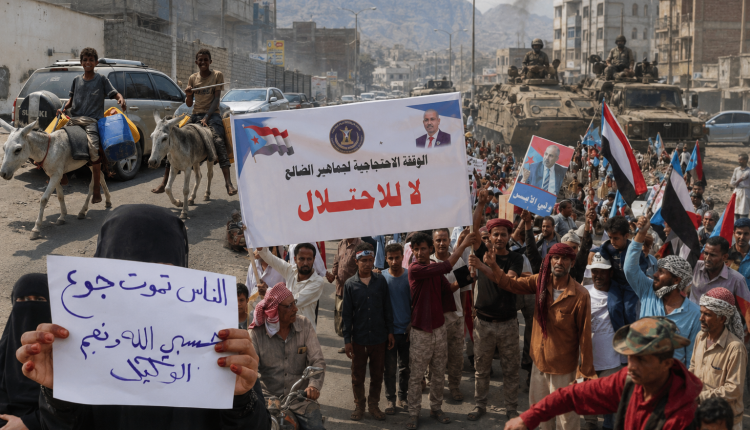
ADEN, July 20 (YPA) –Public demands have grown in Aden and other Saudi-controlled provinces, calling for an end to foreign tutelage and occupation amid years of security turmoil and worsening economic and living conditions since early 2016.
Living conditions have deteriorated further, while Saudi-Emirati promises to southern communities have faded after thousands of young men were pushed into confrontations with Sanaa forces under misleading slogans, turning the region into an arena for internal conflicts and resource depletion.
Despite Saudi and Emirati control over natural resources and major revenues generated from oil, fisheries, ports, and airports, basic services such as electricity and water have seen no significant improvement.
Residents in Aden have faced severe hardships, with reports of people sleeping on the streets and donkeys being used again to transport water for the first time in the city’s history.
These hardships have persisted alongside repeated promises and slogans, including remarks by Saudi-led coalition spokesman Turki al-Maliki after his visit to Shabwa in early 2022, when he pledged to “turn Yemen into the new Europe.” However, the reality on the ground, according to critics, has revealed a severe humanitarian crisis, systematic deprivation in southern Yemen, and the continued exploitation of Yemeni resources, including more than 90 million barrels of oil annually. Critics say the revenues from these resources have been denied to the Yemeni people for development services, while salaries have remained unpaid since the transfer of the Central Bank’s administration from Sanaa to Aden in late 2016.
The situation prompted Sanaa forces to carry out preemptive military strikes targeting the Al-Dhahbah oil terminal in Hadramout and the Al-Nashima port in Shabwa on the Arabian Sea in October 2022. Sanaa described the moves as a national measure aimed at protecting Yemen’s resources.
On the military and political fronts, eastern provinces witnessed escalating Saudi-Emirati rivalry, which reportedly reached its peak in December 2025 after Saudi aircraft targeted an Emirati vessel carrying weapons and military equipment at Al-Mukalla Port.
The strikes were followed by air raids on Southern Transitional Council (STC) factions in Wadi Hadramout, reportedly leaving more than 1,000 people killed or wounded, most of them from Radfan and Al-Dhalea.
The attacks later extended to Al-Dhalea, the hometown of STC leader Aidarous al-Zoubaidi. Riyadh subsequently announced the dissolution of the STC and removed al-Zoubaidi from the Presidential Leadership Council, accusing him of treason, forcing him to flee by sea to Somalia and later to the UAE earlier this year.
Meanwhile, Saudi Arabia has continued efforts to reshape the southern political and military landscape by detaining dozens of STC-affiliated and other political and military figures under house arrest in Riyadh since January, citing a “southern-southern dialogue.”
It has also expanded its influence on the ground, with the help of Islah Party figures, by dismantling STC-affiliated factions and withdrawing their heavy weapons under the pretext of “integration and restructuring,” according to critics.
Amid the worsening humanitarian and political crisis, public anger has grown across Saudi-controlled areas in southern and eastern Yemen, with protesters raising strong slogans calling for an end to Saudi “tutelage” and what they describe as a “war on basic services” and systematic deprivation.
They say these conditions pose a serious threat to Yemen’s stability in both the north and south. Protesters also call for an end to foreign dominance and chant the slogan: “No Saudi from now on.”
@E.Y.M