

Yemeni blockade threatens Saudi oil: indicators of export halt loom on horizon
SANAA, July 27 (YPA) – Indicators are mounting that the blockade imposed by Sanaa on Saudi Arabia has begun to exert direct pressure on the Saudi oil lifeline.
The repercussions have escalated from disrupting tanker traffic in the Red Sea to impacting production and processing facilities as well as supply lines. This opens the door to a far more critical scenario: the impending halt of Saudi oil exports should escalation persist at its current pace.
Consecutive data reveals that the Saudi oil sector is facing simultaneous pressures across multiple fronts. On one hand, Sanaa forces are preventing Saudi oil tankers from transiting the Bab al-Mandab Strait; on the other, vital facilities inside the Kingdom are being targeted. This comes at a time when the cost of shipping oil to Asian markets is surging, rendering the continuation of exports increasingly complex and costly.
In this context, maritime analytics firm “Windward” estimated Saudi Arabia’s losses resulting from the closure of the Hormuz and Bab al-Mandab straits at approximately $504 million—equivalent to 90% of Saudi oil revenues. Meanwhile, “Bloomberg” reported that Saudi oil is now taking a longer route via the Suez Canal to reach Asian markets, signaling that the blockade’s impact has begun to directly alter the trajectory of the Kingdom’s exports.
Data from the satellite intelligence center “Kpler” corroborates this shift in tanker movement. It shows that Saudi crude carriers are opting for the Suez Canal instead of the Bab al-Mandab Strait to evade Yemeni attacks. This rerouting forces vessels onto longer and more expensive passages, incurring additional transport, operational, and insurance burdens.
Bloomberg cited Kpler data showing that the Very Large Crude Carrier (VLCC) “Olympic Luck”, bound for Asia laden with Saudi crude, departed the Red Sea on Sunday evening via the longer Suez Canal route. Meanwhile, military sources in Sanaa confirmed that no Saudi vessels have transited the Bab al-Mandab Strait since last week, reinforcing indications of a complete disruption along this route for Saudi oil exports.
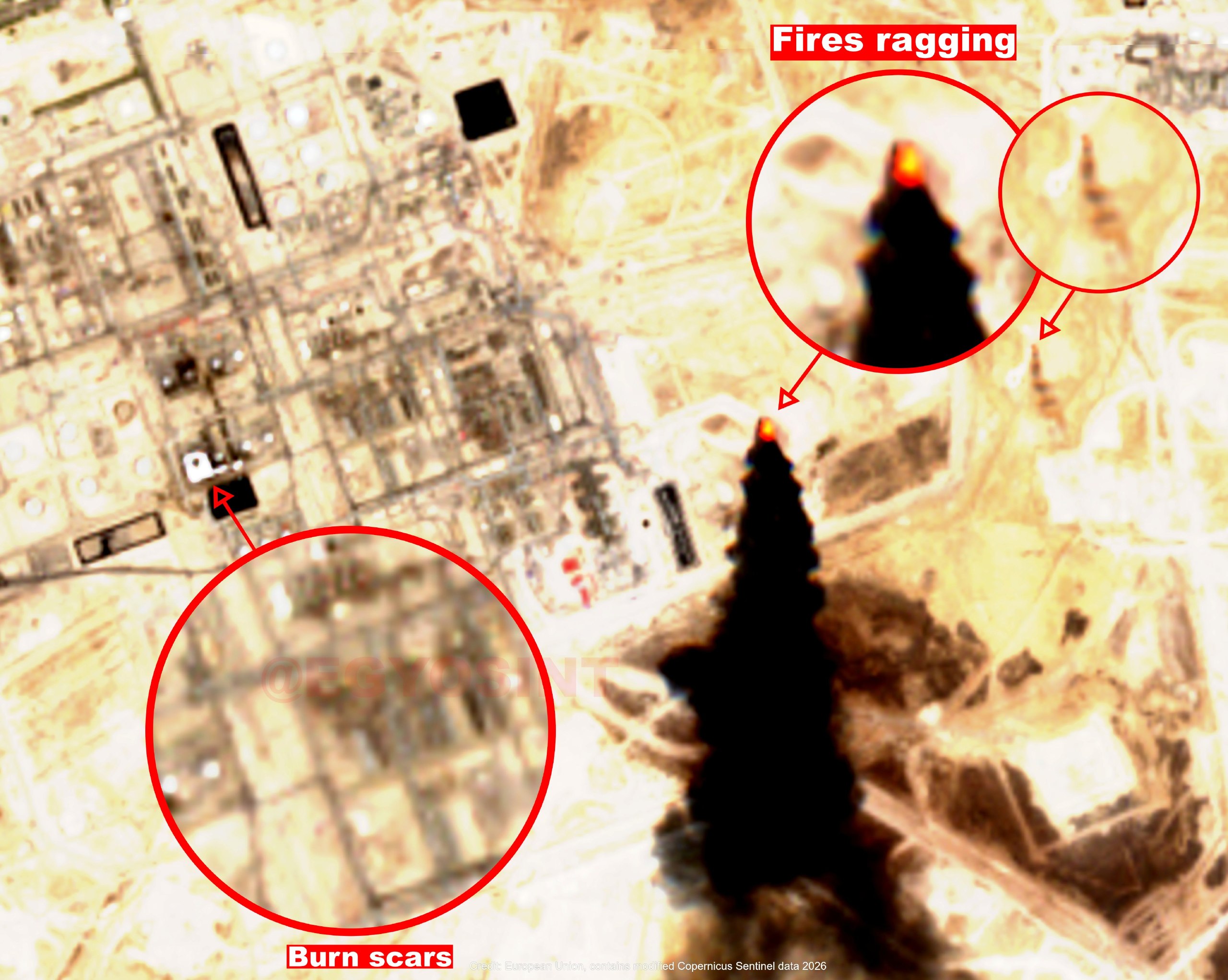
Pressure on Saudi oil exports is no longer confined to shipping lanes; it has extended into the heart of the Kingdom’s energy infrastructure. Sanaa forces targeted Saudi oil supply pipelines extending from the eastern region to the port of Yanbu—an operation confirmed today in a military statement by Sanaa forces. Shortly thereafter, “Aramco” announced the suspension of operations at the Abqaiq refinery amid ongoing fires, as revealed by satellite imagery. The images showed extensive damage inside the oil complex, with four out of six main crude processing units damaged and two completely out of service, while firefighting foam covered parts of one damaged unit, pointing to the extent of operational impairment.
The Abqaiq processing facility holds strategic importance in the Saudi energy network, as it processes crude oil originating from the giant “Ghawar” field before transporting it to export terminals east and west. Consequently, the suspension of its operations serves as an additional bottleneck straining Saudi Arabia’s capacity to maintain crude flows to international markets.
This damage compounds recent hits to Aramco oil facilities in Jizan and Yanbu, which Sanaa forces targeted two days prior. This broadens the circle of pressure on the Saudi oil sector—stretching from navigation routes and tanker lanes to supply lines and critical processing and transport infrastructure leading to export ports.
With these compounding factors converging simultaneously, Saudi oil exports face a series of cascading bottlenecks: the shortest sea route via Bab al-Mandab remains closed, tankers are forced into longer and costlier detours, and processing facilities and pipelines sustain damage that impairs the infrastructure underlying the flow of crude from production fields to export hubs.
Accordingly, cumulative indicators suggest not merely rising costs for Saudi oil exports, but the potential for a broader disruption should energy supply chain nodes remain targeted alongside the ongoing naval blockade. The longer the escalation persists, the greater the pressure becomes on Saudi Arabia’s ability to sustain its entire oil lifecycle—from production and processing, through transport and supply, to final export.
Under this dynamic, Saudi Arabia faces an escalating test: the continuation of the Yemeni blockade, coupled with sustained pressure on oil facilities and supply lines, could incrementally lead to a tipping point where Saudi oil exports risk coming to a full standstill—not due to a single failure, but as a result of compounding pressures across every link in the energy chain.
YPA