

Why did Washington ask China to intervene to open the Strait of Hormuz?
Analysis - YPA Staff
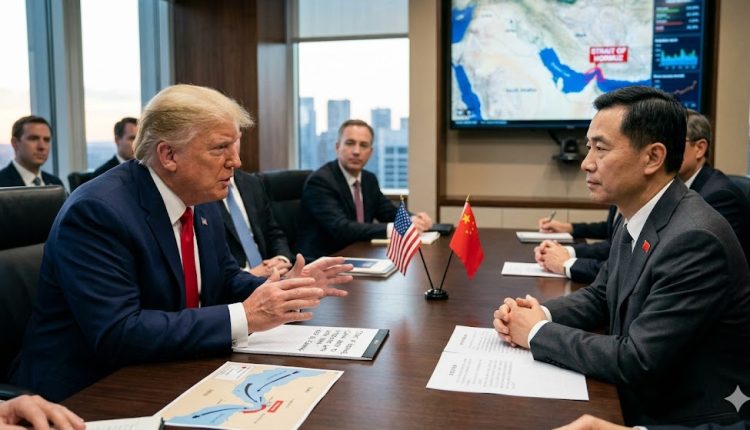
SANAA, May 07 (YPA) – In one of the most striking paradoxes of international politics, Washington has requested China’s intervention to persuade Iran to keep the Strait of Hormuz open to global navigation, at the same time that US President Donald Trump had asserted that Washington controls the Strait by force.
This overlap between the language of military threats and economic diplomacy reveals the true nature of the conflict—one that is not managed by aircraft carriers alone, but is also governed by calculations of oil, trade, and global influence.
The Strategic Importance of the Strait
The Strait of Hormuz is not merely an ordinary maritime passage; it is the world’s most vital energy artery. Any disruption there is capable of igniting oil markets and threatening the entire global economy. Hence, China has emerged as a player that the United States cannot ignore, being Iran’s largest economic partner and the primary beneficiary of the stable flow of Gulf oil.
The contradiction in President Trump’s statements is part of his habitual “negotiating” strategy, where he blends displays of military might with diplomatic and economic pressure.
Rhetoric vs. Reality
On April 23rd, Trump issued a public statement claiming that America controls the Strait of Hormuz, citing the presence of US fleets and destroyers. He followed this by saying the waterway would remain “tightly closed” until Iran reaches a deal. However, the reality on the ground shows that Iran is capable of disrupting navigation, making the US military presence in the region insufficient to guarantee a normal and commercially safe flow of oil.
Today, Washington called on Beijing to use its influence with Iran to reopen the Strait of Hormuz amid escalating regional tensions. This move drew criticism against Washington, viewed as an attempt to shift responsibility to other parties.
This call was voiced by US Secretary of State Marco Rubio and Treasury Secretary Scott Bessent, who urged Beijing to intervene and pressure Tehran to ensure the resumption of maritime traffic in the Strait. This comes ahead of an anticipated summit between President Donald Trump and his Chinese counterpart Xi Jinping in Beijing.
The American call for Chinese intervention reveals Trump’s attempt to transform the crisis from a (US-Iranian) conflict into an international crisis that harms the interests of other superpowers, hoping to push Tehran to open the Strait.
Dual American Escalation
The contradictory American discourse combines military and political escalation on one hand with diplomatic appeals for China to intervene with Iran on the other. Tensions escalated following Trump’s threat to close the Strait by force and the continuation of the blockade, despite the catastrophic economic consequences of such a move.
While facts have proven that US military force is ineffective, it seems Washington can no longer find a solution except by resorting to other international powers—namely China, which the US has long declared an adversary—to rescue the United States from the quagmire of war with Iran.
Despite Trump’s sharp tone, full military control over the Strait of Hormuz carries immense risks, most notably:
- Threatening international navigation.
- A global surge in oil prices.
- Expanding the conflict into a broad regional confrontation.
America seeks to shift the security burden onto powers that benefit from Gulf oil, including European countries. Consequently, Washington believes everyone should participate in protecting maritime lanes to reduce American military costs and force allies and economic partners to shoulder greater responsibilities—a standard tactic in American policy, especially in energy-related crises.
The Chinese Position
China is well aware that what is happening in the Middle East is a result of American policy and Washington’s move to attack certain countries there in partnership with “Israel.” However, Beijing does not pursue the same policy; it operates with balance for the sake of international interest.
Beijing has publicly rejected the American escalation. Chinese Foreign Minister Wang Yi called yesterday, Wednesday, for a “complete” and immediate ceasefire in the region. During talks in Beijing with his Iranian counterpart, Abbas Araghchi, he urged Washington and Tehran to reopen the Strait of Hormuz “as soon as possible.”
According to the ISNA agency, Wang Yi stated that China sees the need to reach a comprehensive ceasefire without delay, emphasizing that “the resumption of attacks is absolutely unacceptable” and that returning to the path of negotiation represents a fundamental step toward ending the crisis.
YPA