

Military installations out of service; is the region entering a “post-US base” era?
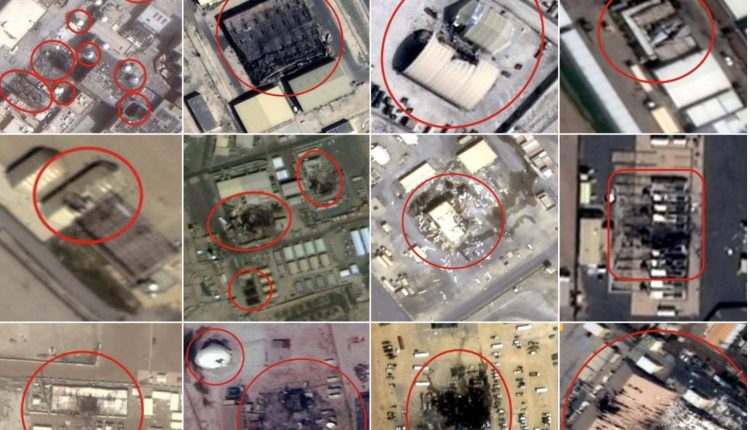
SANAA, May 08 (YPA) – Recent field developments in the region have unveiled a new strategic reality, as intelligence reports and satellite imagery suggest that the US military presence is no longer what it was prior to February 28—the date of the second aggression launched against the Islamic Republic of Iran.
While the US administration attempts to practice a policy of “narrative control,” leaked images expose a scale of destruction that has rendered major US facilities in the region mere “disabled shells” or installations effectively out of service.
Map of Destruction: Figures Exceeding Expectations
The Iranian strikes were not merely random reactions, but surgical blows targeting the “nerve center” of American power.
According to a recently published investigation by “The Washington Post” newspaper, Iranian strikes resulted in the damage or destruction of at least 228 strategic facilities and pieces of military equipment across US bases.
Interestingly, Western reports align closely with the Iranian military narrative regarding “field effectiveness” and the destruction of US bases in the region. The Washington Post, which published satellite imagery of the devastated sites, confirmed that Iran inflicted severe damage and massive destruction on US military installations, noting that losses in the “Middle East” far exceed what has been officially announced.
The Washington Post is not alone in uncovering this reality; a prior CNN investigation revealed that at least 16 US bases in the region sustained direct hits, ranging from partial to total destruction.
The Economic Bill: A Multi-Billion Dollar Hemorrhage
Beyond the physical ruins lies an unprecedented financial drain on the US Treasury. While the Pentagon attempts to downplay the figures before Congress, independent estimates point toward a financial catastrophe.
Although the Pentagon officially declared $25 billion as the cost of the confrontation, media outlets such as CNN and CBS assert that the true cost is at least $50 billion, factoring in reconstruction, replacement of sensitive equipment, and operational costs incurred during the wartime period.
A Truce Forced by Reality
In light of this reality, Washington’s pivot toward a diplomatic track appears to be a matter of necessity rather than choice.
Following rounds of talks in Pakistan after the April 8 truce, and President Donald Trump’s extension of the ceasefire without a fixed deadline, it seems the United States is searching for an exit strategy to salvage its remaining military prestige After its rules became fixed and easily attainable goals.
The qualitative shift in this confrontation lies in the fact that American “technological superiority” collided with the density and precision of Iranian strikes, which focused on communication infrastructure and radar systems. The result is a region currently witnessing a “post-US base” stage, where these facilities—once centers of control and influence—have transformed into security and financial liabilities.
YPA