

Video: Saudi Arabia raises secession flag in Riyadh, replacing Yemen’s unity flag
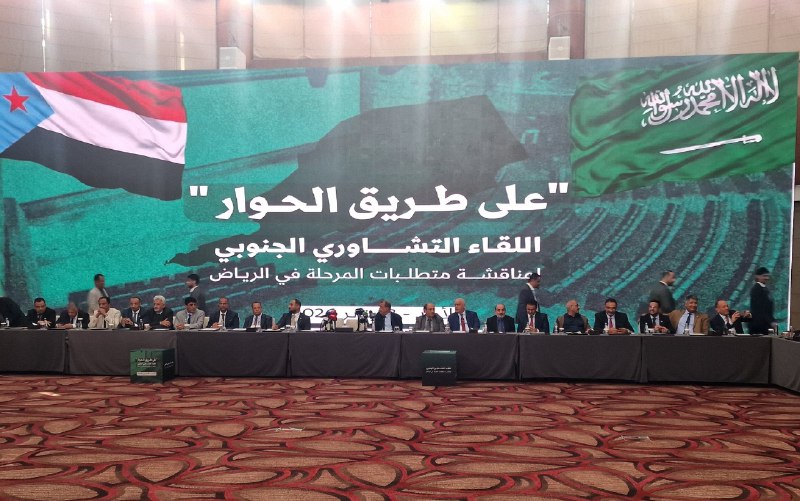
RIYADH, Jan. 18 (YPA) – Raising a secessionist flag and playing the anthem of the so-called People’s Democratic Republic of Yemen during the opening of dialogue consultations among southern factions in the Saudi capital, Riyadh, on Sunday posted a high-level diplomatic and political precedent.
This development went beyond a mere ceremonial or protocol gesture and instead signals fundamental shifts in Saudi Arabia’s strategic approach and in the internal balance of power within the so-called “legitimacy” camp.
This moves effectively granted regional legitimacy to the secession project, reflecting an implicit—if not explicit—acknowledgment from Riyadh that the division of Yemen has become an active item on the regional decision-making agenda. It also suggested that Saudi Arabia, which has led the war on Yemen since March 2015 with U.S., European, and Israeli support, is recalibrating its political objectives in light of changing regional dynamics.
In parallel, Riyadh appeared to be engaging directly with southern political and military components following its growing divergence from the United Arab Emirates, particularly after the weakening of the Emirati-backed Southern Transitional Council (STC) and its effective withdrawal from the coalition framework. This shift indicated that Saudi Arabia was seeking to independently manage the southern file in accordance with its own strategic interests.
Meanwhile, the head of the Saudi-formed Presidential Leadership Council (PLC), Rashad al-Alimi, appeared to function as a temporary political umbrella facilitating the fragmentation of Yemen, alongside other PLC members. This underscores Saudi Arabia’s role in redrawing the political map of southern Yemen and restructuring power arrangements to accommodate a separation-oriented trajectory.
What is unfolding in Riyadh can therefore be interpreted as a soft declaration of Yemen’s fragmentation. Under the banner of “bringing viewpoints closer together,” current efforts are focused on organizing the separation project so that it has emerged as a unified and independent actor in any comprehensive final settlement of the Yemeni conflict.
This process has accelerated the erosion of the concept of a unified Yemeni state, which was first severely undermined under the banner of “Decisive Storm,” in favor of regional-sponsored partition agendas.
Ultimately, the diplomatic track in Riyadh has extended beyond short-term local accommodation and aims to institutionalize a new political reality. As such, the outcomes of these consultations are likely to formalize an existing state of fragmentation under regional sponsorship, rather than advance a genuine national settlement.