

Political-military shockwave in eastern Yemen… Scenarios of Saudi–UAE confrontation
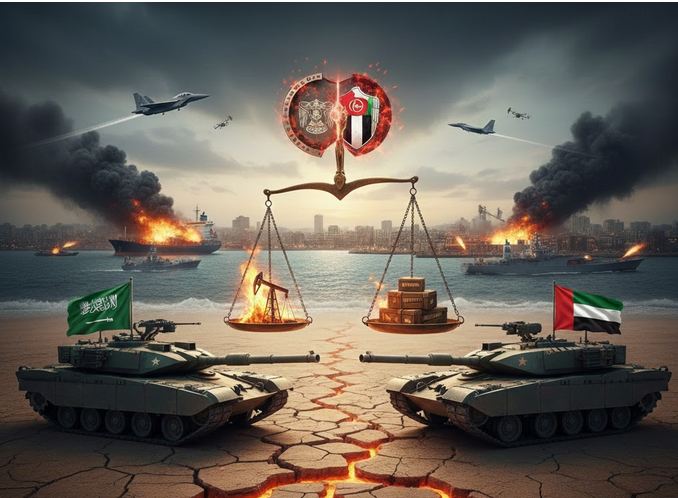
SANAA, Dec. 30 (YPA) – The final days of December 2025 witnessed an unprecedented escalation in tension between Saudi Arabia and the UAE in eastern Yemen, particularly in Hadramout and Mahra, after the dispute moved from the framework of political rivalry and a cold war” to an almost direct military confrontation accompanied with strict diplomatic measures.
In a dangerous development, the Saudi-led coalition forces carried out airstrikes earlier in the day targeting the port of Mukalla in Hadramout province, following an official demand to evacuate the port before carrying out the strike. Riyadh announced that the raids targeted a shipment of weapons and combat vehicles that arrived from the UAE port of Fujairah, which was intended to strengthen the forces of the Abu Dhabi-backed Southern Transitional Council (STC), considering that the shipment poses a threat to security and stability and an unacceptable escalation.
The official Saudi Press Agency said the coalition forces carried out a limited military operation in the port of Mukalla targeting what it described as an arms shipment coming from the UAE to Yemen, noting that the coalition demanded to evacuate the port immediately in order to ensure the safety of civilians, before carrying out the raid that targeted external military support points.
According to media sources, two UAE ships arrived at the port of Mukalla over the weekend without official permits, and turned off Automatic Identification and tracking systems before unloading weapons shipments at the port.
The coalition spokesman, Turki al-Maliki, said that the operation was carried out at the request of the head of the Presidential Leadership Council (PLC), Rashad al-Alimi, pointing out that the PLC, in conjunction with the raids, took conclusive decisions, including the cancellation of the joint defense agreement with the UAE, declaring a state of emergency for 90 days, and imposing a comprehensive ban on land and sea ports for three days.
Saudi Arabia also gave the UAE a 24-hour deadline to withdraw its forces from Yemen and stop supporting any local parties, based on al-Alimi’s decision to end Abu Dhabi’s role within the coalition.
This escalation came after the STC launched a military operation budded “the promising future”, during which it controlled large areas in Hadramout and Mahra, while Saudi Arabia supported the Hadramout Tribal Alliance and the Saudi-funded Dera al-Watan forces to prevent the STC from tightening its grip over the oil areas in PetroMasila, a Yemen’s main national oil and gas company, and border areas.
On Tuesday, Saudi Arabia issued a statement expressing regret for what it described as” the UAE’s pressure on the STC forces to carry out military operations in eastern Yemen on the southern borders of the Kingdom, warning that such actions constitute a direct threat to Saudi national security and describing the Emirati steps as extremely dangerous and inconsistent with the foundations of the coalition.
Riyadh stressed that its national security is a red line, promising to take all necessary measures to confront and neutralize any threat.
On the other hand, Abu Dhabi condemned the Saudi statement and considered it to contain “fundamental fallacies,” stressing that the shipment of weapons targeted in Mukalla belongs to the UAE forces operating within the coalition, and that it was the subject of prior coordination.
For his part, the STC’s deputy chairman, Hani bin Brik, said in a post on the “X” platform, that an official Saudi attack on Hadramout and its civilian port was a flagrant violation of international humanitarian law. He added that the port represents a vital economic artery for the province, accusing the coalition of practicing “media and political disinformation” to justify the military operation.
In the same context, the chief of staff and commander of joint operations, Saghir Bin Aziz, considered that the limited military operation in the port of Mukalla came after exhausting the means of dialogue, describing it as a necessary step.
In turn, the deputy chairman of the STC, Ahmed Saeed bin Breik, issued a warning to Saudi Arabia, saying that the council has “weighty” documents and information that have not yet been used, but will reveal “many facts” if forced to do so. He added that the chairman of the PLC has lost what remains of his political and moral legitimacy on the ground.
This escalation has reflected a deep divergence in strategic visions between Riyadh and Abu Dhabi. Saudi Arabia sees Hadramout and Mahra as part of its secure sphere of influence and would continue to support the forces of the “Dara al-Watan” and allied tribal components. In return, the UAE maintains its support for the STC’s project, which seeks to secede and control the eastern and southern geography of Yemen, turning regional rivalry into an open confrontation.
Observers suggest three possible scenarios for the outcome of the conflict:
The first scenario involves a power-sharing arrangement, whereby Al-Mahra and Wadi Hadramout would remain under direct Saudi influence, in exchange for granting the UAE and the Southern Transitional Council full control over Aden, the Hadramout coastline, and the Balhaf port.
The second scenario, described as a “clash and forced withdrawal,” envisions continued Saudi military pressure prompting the UAE to carry out a tactical repositioning, withdrawing its formal forces while maintaining indirect support for its local allies. Such a development could push the situation toward broader internal conflict in areas under coalition control.
The third scenario is the continuation of the current status quo, characterized by fragmented spheres of influence: Saudi Arabia maintaining control over airspace and land borders, while the UAE-backed STC controls territory and ports on the ground, with limited skirmishes persisting and no decisive resolution in sight.
The duration of the trajectory of the conflict will depend on the Saudi ability to impose a new reality through the Dera al-Watan forces, and the extent to which the UAE withstands escalating diplomatic pressure, which reached the point of demanding the withdrawal of its forces within a 24-hour timeframe.
AA