

Chinese satellites reveal US escape plan to Yanbu, Saudi Arabia
Unprecedented fortifications documented
While Washington claimed to be protecting navigation, Chinese satellite cameras were detecting the construction of “secret bunkers” deep within Saudi territory… Here are the details of the US military’s great escape from the inferno of confrontation
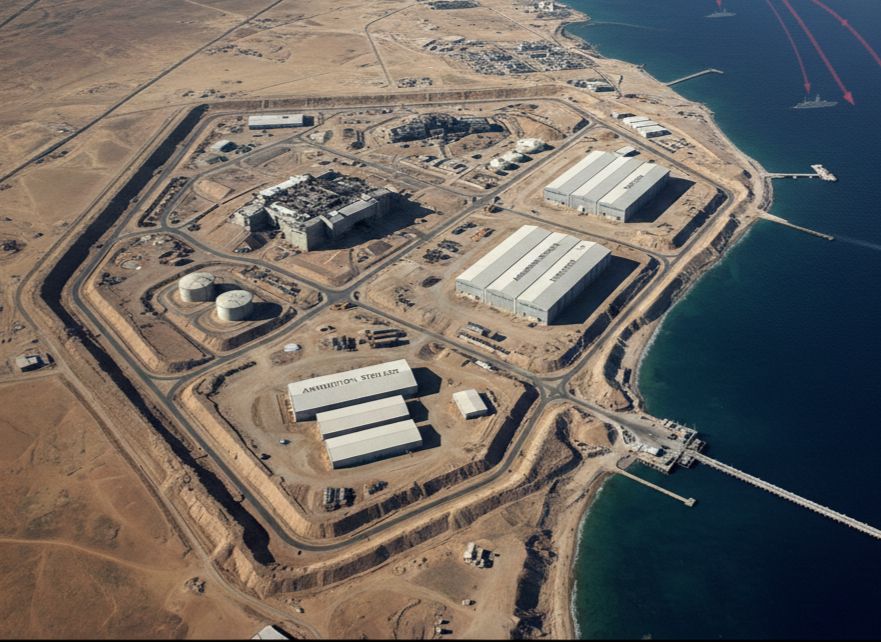
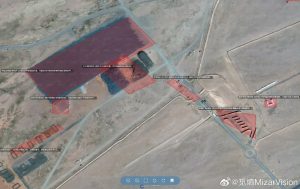
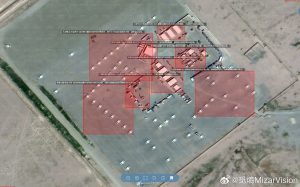
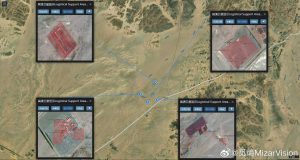
SANAA, Feb. 14 (YPA) – In a development revealing the features of a U.S. strategic fracture in the face of qualitative Yemeni naval operations, high-resolution satellite imagery published by the Chinese platform “MizarVision” has exposed extensive and suspicious military expansions by the U.S. Army at the “LSA Jenkins” logistical support base in the Saudi city of Yanbu.
Military observers interpret this move as a “tactical escape” from the inferno of Yemeni strikes that have targeted the pride of the American military industry in the Red and Arabian Seas.
“From Support Point to Fortified Barracks”
The leaked images document a radical transformation in the facility’s infrastructure. What was once a transient support point has evolved into a major barracks featuring fortified underground bunkers, massive ammunition depots, and complex infrastructure.
Through these measures, Washington aims to establish a “safe haven” for its forces, positioned beyond the reach of ballistic missiles, cruise missiles, and drones launched by Sanaa forces—which have demonstrated a superior capability to penetrate the most advanced defense systems.
Furthermore, the specific choice of Yanbu represents a desperate American attempt to distance itself from the range of potential Iranian missile strikes should a direct confrontation erupt between Tehran and Washington, seeking a geographical depth that might mitigate the expected cost of losses.
“The Failure of Confrontation”
This frantic American movement in Yanbu is organically linked to the dismal failure Washington has suffered in the battle of the Red and Arabian Seas.
The U.S. Central Command (CENTCOM) is actively searching for rear bases to provide protection for its elite units and forces from the expanding Yemeni “bank of targets,” which has rendered traditional U.S. bases in the region easily accessible targets.
The American resort to fortifying the Yanbu base with new shelters and additional housing reflects a stark reality: the Red Sea has become a “forbidden zone” for U.S. naval vessels.
This explains the political backdrop of several months ago, when Yemeni operations against U.S. warships and aircraft carriers were halted under an agreement Washington earnestly sought through Omani mediation.
This followed heavy losses and a field-level inability to confront or deter precision Yemeni missile strikes, leading the U.S. to find in Yanbu an emergency alternative and a logistical launching pad to refuel and rearm its destroyers away from direct engagement zones that have humbled its pride.
“Shifting Engagement Equations”
Military analysis of this expansion indicates that Washington now realizes its previous bases in the region no longer provide sufficient protection against the growing capabilities of the Axis of Resistance.
The transition to Yanbu represents a tacit admission of the superiority of missile capabilities that have imposed new equations of engagement, making “fleeing into the interior” the only option left for the Pentagon to avoid a total collapse of its forces.
While Washington claims to protect international navigation, these images prove its primary concern has shifted to protecting the “remnants of its prestige” and its forces, which are now caught in a pincer movement of escalating operations.
By turning Saudi territory into a launchpad for its aggressive operations and a backyard to repair its successive fractures, the U.S. is reacting to the steadfast Yemeni position supporting the Palestinian people in Gaza. It is this very position that has forced the self-proclaimed “Mistress of the Seas” to bow to regional mediations to seek safety for its vessels after the language of fire failed to protect them.
YPA