

Dhamar Zakat authority launches economic empowerment project for 75 beekeeping families
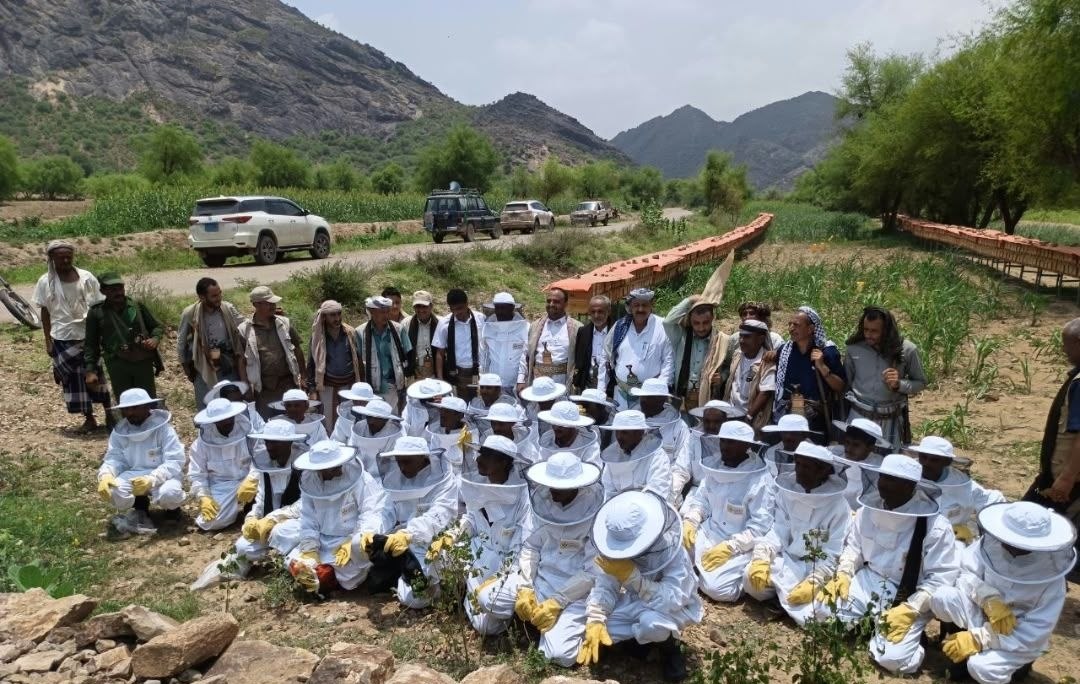
DHAMAR, Aug. 28 (YPA) – The General Zakat Authority’s office in Dhamar province, in cooperation with the Wasab Al-Safil Multi-Purpose Agricultural Cooperative Society, launched on Friday an economic empowerment project targeting 75 families in the district through beekeeping, honey production and marketing, at a total cost of 95 million rials.
The project includes the distribution of 1,875 beehives to beneficiary families in the areas of Bani Sawadah, Wadi Al-Khashab and Al-Majouhi, funded by the authority in cooperation with the Ministry of Agriculture and Fisheries, the local authority, Bonyan Development Foundation, and the Wasab Al-Safil Agricultural and Nahali Al-Munira cooperative societies in Hodeida province.
The support includes beehives and beekeeping and production equipment, as well as honey extraction, filtering and purification machines and a fully integrated packaging line capable of filling containers ranging from 100 to 750 milliliters in accordance with modern standards.
In the presence of the head of the district’s Local Council Planning, Development and Finance Committee and chairman of the cooperative society, Mohammed Al-Alawi, Dhamar Zakat Authority branch director Ibrahim Al-Mutawakkil said the authority did not view economic empowerment as temporary programs, but would seek to expand such projects into other development areas, including cattle raising and the production of milk, meat and clarified butter, studies for which are currently being completed.
Al-Mutawakkil added that Zakat funds are distributed through their legally designated channels through sustainable and specialized projects, ranging from economic empowerment to medical assistance and support for people unable to work. He noted that a program supporting people unable to work targets around 4,500 beneficiaries across the governorate, providing 20,000 rials to each beneficiary, and urged families to make optimal use of the support to ensure sustainable production.
For his part, Wasab Al-Safil District Zakat Authority branch director Ali Al-Alawi said the volume of projects and assistance provided to the district exceeds the amount collected from it by hundreds of millions of rials, stressing that the funds are distributed with full transparency to beneficiaries and the wider community.
He said the beneficiaries’ success in managing the projects would strengthen public confidence in the effectiveness of economic empowerment programs in combating poverty and developing local communities.
Meanwhile, Hashim Al-Kahlani, director of the Zakat Authority’s Economic Empowerment Projects Department, said work was underway to establish village-level production groups among beneficiary communities to strengthen cooperation among beekeepers. He said this was being done in cooperation with the Wasab Al-Safil society to ensure that Wasabi honey is marketed using modern methods while preserving its quality and commercial reputation.
Al-Kahlani said proceeds from the projects would be allocated to financing interest-free loans and similar projects in other areas of the district. He added that beneficiaries had been selected through a detailed mechanism focused on poor and needy families with experience in beekeeping, who had undergone intensive training and qualification programs. He urged them to follow technical guidance to preserve the equipment and ensure the project’s success.
The head of the Beekeepers Association in Al-Munira district of Hodeida, highlighted the importance of the initiative in empowering poor families by providing small income-generating projects.
He said beekeeping and honey production in Wasab represented a significant opportunity given the reputation and quality of Wasabi honey and its popularity in local markets, urging beneficiaries to improve production efficiency and honey quality.
Abdulraqeeb Al-Salihi, the planning official at the Wasab Al-Safil Multi-Purpose Agricultural Cooperative Society, also outlined the importance of the project in empowering honey producers, increasing honey production and expanding the producer base in Wasab, while introducing modern technologies into honey extraction processes.
He affirmed that the cooperative society would purchase and market the honey and provide beneficiaries with advisory and follow-up services to help develop their production and establish suitable marketing channels for their products.
AA