

Yemeni deterrence earthquake: “Ban for ban and depth for depth”
SANAA, July 04 (YPA) – Recent field developments in Yemeni airspace confirm that the military and political landscape has entered a decisive turning point. This shift carries strategic transformations that place the entire region before unprecedented options, following the Saudi attempt to violate national airspace at dawn today (Friday).
This move was met with a decisive Yemeni rejection and triggered a comprehensive mobilization within the ranks of the Armed Forces, which quickly declared full readiness to execute responses transcending all conventional calculations that Riyadh and its allies have grown accustomed to.
Sanaa’s Reading of the Escalation: Sovereign and Political Dimensions
This Saudi move—which Sanaa interpreted as an open test of the limits of patience—was not understood solely within its narrow tactical context. Instead, it was placed within a broader political framework. The leadership in Sanaa considers the continuation of these adventures a blatant violation of state sovereignty and an extension of the systematic aerial blockade policy that has targeted Sanaa International Airport for years.
Consequently, the upcoming response, according to the political vision in Sanaa, will not merely be a defensive military action. Rather, it will be a functional translation of a firm political stance affirming that the new deterrence equation is the sole guarantor for protecting sovereignty and restoring legitimate rights.
The New Rules of Engagement: A Comprehensive Target Bank
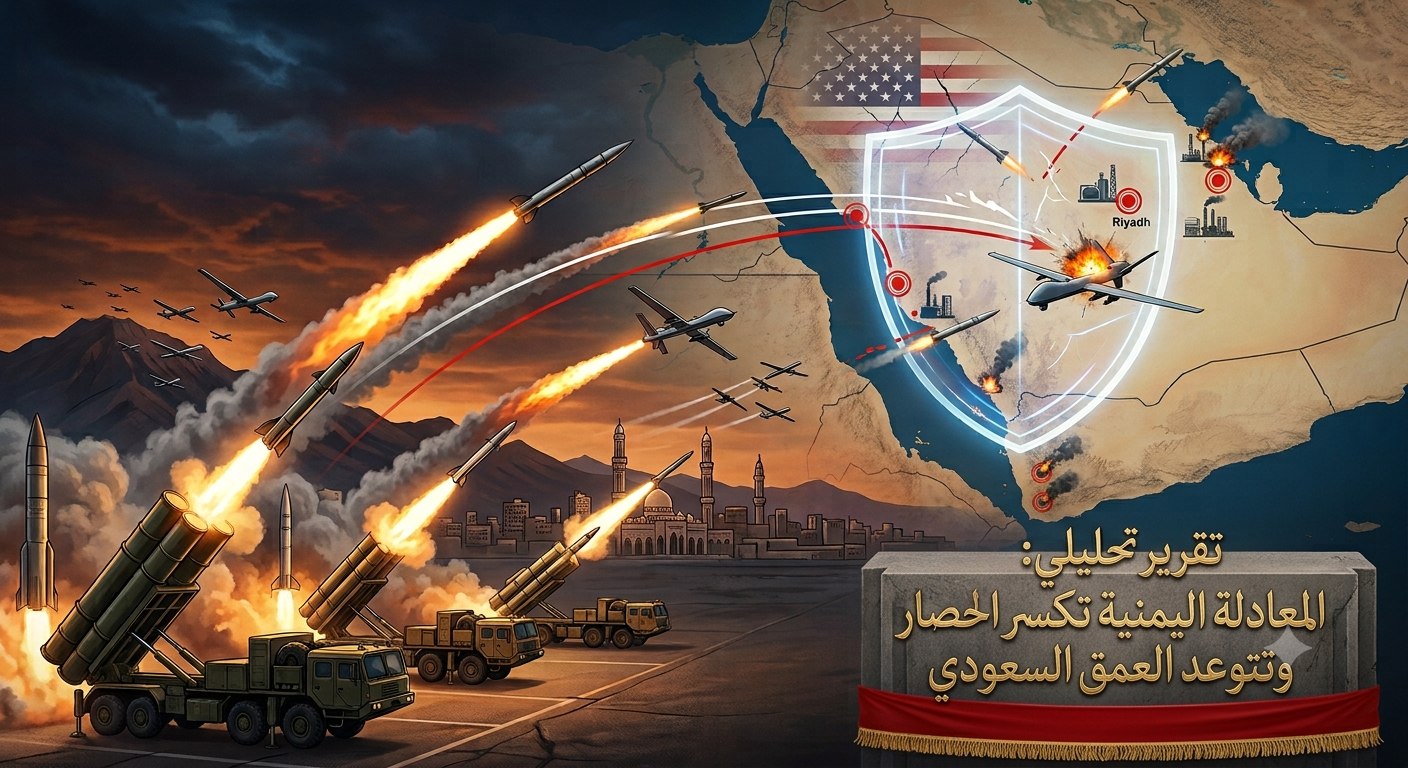
In this context, military analysts and observers believe that the leadership in Sanaa has established a clear deterrence equation based on a golden rule that leaves no room for misinterpretation: any repetition of these hostile practices will directly activate a wide-ranging bank of targets covering the entire geopolitical and economic geography of the Kingdom.
The Missile Force and the UAV Air Force have prepared an offensive system that includes:
- Vital Oil Facilities: Crucial energy infrastructure across the Kingdom.
- Hub Airports: Key civilian and military airports.
- Strategic Ports: The vital arteries of the Saudi economy.
- Military Bases: Distributed across various regions.
Military warnings issued from Sanaa confirmed that the next response will not be limited or tactical; rather, it will swiftly transition into a broad strategic offensive aimed at completely paralyzing the economic and military movement of the aggression side.
This is where this equation acquires its deeper political dimension, as Sanaa no longer views its missile and aerial capabilities merely as tools of pressure, but as deterrent and negotiating cards that impose a new reality on the table of any future dialogue. The ability to disrupt oil supplies or halt air traffic grants Yemen exceptional leverage unavailable in previous decades.
Hence, the political call from Sanaa highlights the necessity of rethinking all calculations built on the premise of Saudi aerial superiority. The military era has changed, and Yemen is now capable of imposing rules of engagement that protect its sovereignty and strike the interests of whoever aggresses against it.
Breaking the Blockade and Imposing Full Sovereignty
Within this framework, the new Yemeni equation emerges as a decisive factor no longer confined to the battlefield, but as an influential element in the comprehensive political equation. Sanaa has practically succeeded in breaking the aerial blockade imposed on Sanaa International Airport—not through abstract political positions, but by holding the levers of deterrence that have made the continued banning of civilian aircraft extremely costly for Riyadh.
Thus, maritime and civilian traffic are asserting themselves as both a field and political reality simultaneously. This reveals a genuine transition for Yemen from a stage of mere defense and shock absorption to an advanced stage of imposing full sovereignty over its airspace and airports.
With this, Sanaa has brought an end to an entire era of external control over its humanitarian and sovereign files, replacing it with a new methodology based on the principle that rights are not extracted through negotiations alone. Instead, they become a humanitarian and political necessity imposed by the balance of power on the ground, reflecting a deep political reading by the leadership in Sanaa of modern state concepts that derive legitimacy and strength from the capacity to protect sovereignty and the interests of the people.
Qualitative Technological Leaps and Bypassing Defense Systems
Parallel to this development, analytical data issued by international research centers, including American centers, indicate that Yemeni military capabilities have witnessed unprecedented qualitative leaps in recent years. Vast tactical and technological expertise has accumulated in dealing with Western and American air defense systems. This has made Yemen a unique model in the region for the capability of a non-conventional state to develop localized weapons counter to the latest outputs of the global military industries.
These reports confirm that modern Yemeni tactics, based on combining large-scale attacks using low radar signature drones with hypersonic ballistic and cruise missiles, are fully capable of disrupting and thwarting the effectiveness of defensive barriers, including the American Patriot and THAAD systems, and reaching their targets with extreme precision and direct destructive hits.
This technological and military achievement was not realized in isolation from Sanaa’s political project; it is part of a broader political strategy aimed at transforming the military equation into a lever for achieving political goals, represented by the recognition of full Yemeni sovereignty and ending foreign subordination.
Furthermore, these advanced capabilities grant Sanaa a wide margin of political maneuver, allowing it to present itself as a regional power that cannot be ignored in any regional settlement. This is clearly manifested in the Yemeni approach to crises: responding to airspace violations is no longer just a military procedure, but has become an implicit political message to the international community that Sanaa possesses the tools of influence that render any solution non-viable without its active participation.
The Illusion of the American Umbrella and Regional Security Shifts
In the analytical context of regional political dimensions, experts unanimously agree that the continuous Saudi reliance on the security umbrella and American protection has proven to be a dismal failure at recent and pivotal historical junctures. The current scene brings to mind the devastating strike that hit Aramco facilities in Abqaiq and Khurais, which disrupted half of Saudi oil production without American military technology being able to detect or prevent it—a strategic lesson that should have altered all of Riyadh’s calculations.
However, the recent escalation indicates that Saudi Arabia is still gambling on different calculations, perhaps due to internal pressures or flawed assessments of Sanaa’s capabilities.
In this regard, data from recent regional confrontations—specifically the Iranian-Zionist war—reinforce the field reality that Washington is incapable of securing its allies in the region when wide-scale, intensive confrontations break out, and that its scattered bases have turned into targets themselves rather than being a shield for allies.
This reality places Sanaa in an excellent political position to capitalize on the decline of American confidence in the region. It allows Sanaa to present itself as a party capable of stabilizing the security equation in a manner aligned with its national interests. This is evident in the political discourse, which no longer speaks of defense alone, but has begun to introduce new concepts regarding shared regional security based on mutual respect rather than hegemony.
Sanaa is fully aware that any future political solution must include actual security guarantees. These guarantees cannot come from external powers as much as they can come from building a new regional system in which Yemen plays a pivotal role in defining the rules of the game, rather than being a mere recipient of decisions.
Conclusion: The Strategic Patience is Ending
In-depth field and political readings conclude that Sanaa, by establishing new rules of engagement that protect national sovereignty and place the aggressor’s interests within the line of direct targeting, has clearly sent its final message to all parties. It underscores that the phase of strategic patience exercised by the leadership is nearing its end, and that any new Saudi folly will be met with practical measures capable of ending Riyadh’s political and military gambles.
The door is no longer open to maneuvers that reproduce the same failed scenarios. Moreover, Sanaa’s political position today has transcended the demands of lifting the blockade or stopping the aggression, moving toward presenting a comprehensive vision for relations with neighboring countries based on the principle of equality, mutual respect, and non-interference in internal affairs.
This is a radical shift in political discourse that grants Yemen a new status on the map of regional alliances. Sanaa is no longer just a party to a conflict; it has become a primary player in shaping the future of the region. This renders future options contingent upon the extent to which the other side absorbs the warning messages launched by the leadership, and Riyadh’s ability to realize that continuing its old approach will only bring further unsustainable economic and political losses.
Meanwhile, Sanaa has demonstrated over the past years that it is capable of patience and steadfastness, and that it holds a clear vision for its future that cannot be based on anything less than full sovereignty and true independence.
Consequently, the ball remains in Riyadh’s court today, facing a real test of its ability to read major transformations, or to persist in its miscalculations that push the region toward broader confrontations whose consequences no one can predict.
YPA