

Sheikh Naim Qasem: ‘Government should step down if it fails to ensure sovereignty’
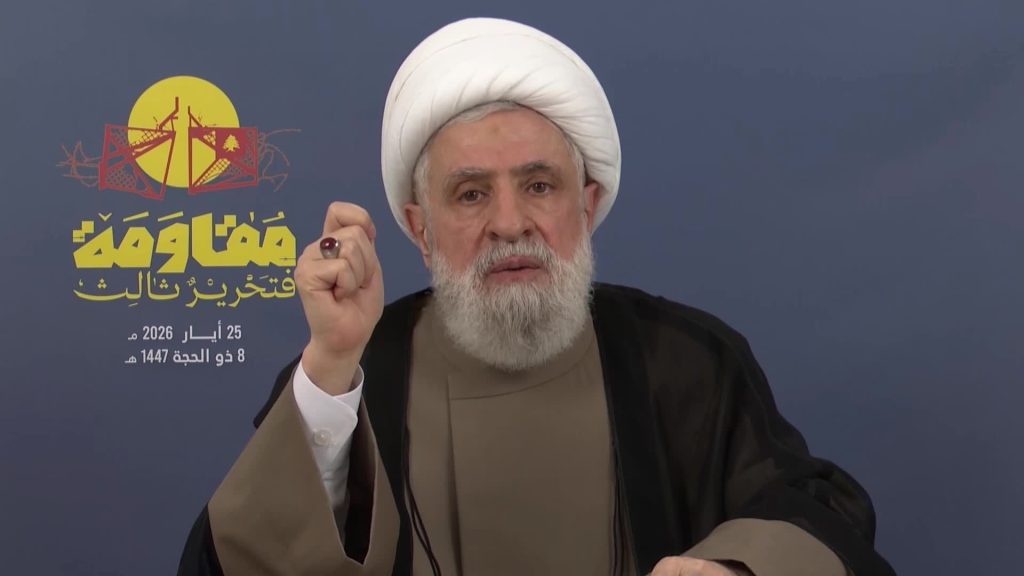
BEIRUT, May 24 (YPA) – Hezbollah’s Secretary-General Sheikh Naim Qasem emphasized that the resistance is the result of the collective struggle of all national and honorable fighters, with liberation achieved through their shared sacrifices.
He praised Imam Musa al-Sadr for his crucial role in strengthening the resistance approach.
Sheikh Qasem highlighted that the late Lebanese President Salim al-Hoss, along with other presidents, provided substantial support for the liberation cause and its defense. He described the Resistance and Liberation Day as a historic milestone marking the first humiliating withdrawal of the Israeli occupation, a victory for Arabs, Muslims, and especially the Palestinian people.
He underscored the essential partnership between the people and the army in securing liberation and victory, noting that the combination of roles and sacrifices formed the foundation of “the army, the people, and the resistance,” reflecting the national role the Lebanese state played at the time.
The Secretary-General pointed out that in 2000, under presidents Emile Lahoud, Nabih Berri, and Salim al-Hoss, the Lebanese leadership supported and protected the liberation effort. In contrast, he criticized the current authorities for “criminalizing resistance and making unwarranted concessions to the enemy.”
Sheikh Qasem insisted that the Palestinian Authority must act in accordance with the people’s will and remain accountable to the Lebanese. He vowed to confront Israeli occupation and its allies with full strength, dignity, and sacrifice.
He criticized the Lebanese government’s failure to achieve sovereignty and challenged it to step down if it cannot secure it, questioning its accomplishments during its tenure.
Hezbollah’s Secretary-General firmly rejected direct negotiations with the Israeli occupation, calling them a “clear gain for Israel,” and advocated for returning to indirect negotiations based on national consensus.
Declaring resistance unwavering despite increasing pressure, he affirmed that “the heroes of the resistance embody honor and patriotism” and will remain active on the ground.
He dismissed US sanctions as ineffective against the resistance and warned that continued American pressure would worsen Lebanon’s situation.
Regarding the Al-Qiard Al-Hassan foundation, he condemned attacks on it as aggression against hundreds of thousands of poor and low-income people, labeling efforts to shut it down as an “American-Israeli project” that will be resisted.
He warned that disarming the resistance would leave Lebanon defenseless, stripping it of vital strength to protect its wealth and existence. He described calls for disarmament as a prelude to the country’s “annihilation,” given Israel’s expansionist and ongoing aggression.
Sheikh Qasem stressed that the current regional conflict is not someone else’s war but a direct threat to their existence. He saluted the resistance fighters whose sacrifices secured liberation achievements.
He extended solidarity to Palestine and the Qassam Brigades, affirming that the Palestinian cause remains a central guiding principle.
On regional matters, Sheikh Qasem predicted that Iran would emerge from the conflict with its dignity intact and its international status strengthened.
He urged Lebanese authorities to inform the United States of their inability to meet its demands and to instead rely on Lebanon’s unique and significant strengths.