

Trump in the Hormuz “trap”… Empty threats to confront a vigilant arsenal
Analysis
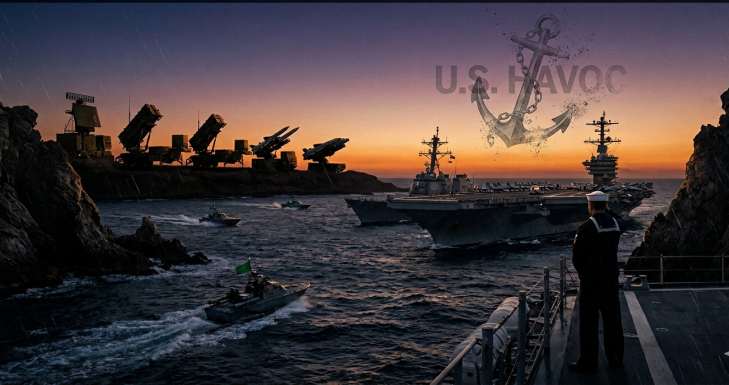
SANAA, April 14 (YPA) – The announcement of the failure of the Islamabad negotiations between Tehran and Washington was not merely a passing diplomatic stumble; rather, it was an explicit declaration of the collapse of the last cards of “political blackmail” that the White House attempted to brandish against Iranian sovereignty.
While Donald Trump was waving the “baton” of a naval blockade on the Strait of Hormuz, Iran was placing the language of “Rights and the Field” on the table, affirming that the security of maritime corridors is not an American grant to be given or withheld, but a reflection of the sovereignty of the coastal states.
Accordingly, Trump’s threats to blockade Hormuz are nothing more than a “flight forward” from the reality of “military failure” experienced by his fleets in the Red Sea at the hands of the heroes of Yemen.
The resident of the White House realizes that any attempt to militarize the Strait or tighten the grip on Iranian oil exports will ignite a global economic “suicide fuse,” as energy prices will turn into an earthquake hitting the American depth before any other.
In a related context, Iranian steadfastness during the 21-hour negotiations proved that the era of “dictates” is over, and that the field today is governed by the equation of “Security for all or security for none.” This is the equation that has made Hormuz resistant to “piracy” and left America drowning in its strategic disorientation.
Returning to the details of the scene, after more than 20 hours of marathon negotiations in the Pakistani capital, Islamabad, the highest-level round between Iran and the United States in decades ended without an agreement.
These negotiations involved a high-level American delegation led by Vice President JD Vance, against an Iranian delegation headed by the Speaker of the Islamic Consultative Assembly Muhammad Baqir Qalibafand Foreign Minister Abbas Araghchi.
It is clear that the disagreements were not technical but fundamental, centered on the nuclear program, sovereignty over the Strait of Hormuz, and the conditions for lifting sanctions. While US President Donald Trump announced the failure—citing Iran’s refusal to concede its ambitions—the Iranian side emphasized that Washington presented unreasonable demands and failed to gain Tehran’s trust, stressing that the era of dictates has passed.
Reasons for Failure from Both Perspectives
The Iranian Position: Lack of Trust and Excessive Demands
Speaker of the Islamic Consultative Assembly Muhammad Baqir Qalibafand described the atmosphere as dominated by a lack of trust, affirming that Tehran possesses good faith but does not trust the American side.
According to Iranian sources, Tehran proposed forward-looking initiatives that were met with American rejection of legitimate demands, including:
- The complete lifting of sanctions.
- Compensation for war damages.
- Recognition of full sovereignty over the Strait of Hormuz.
- A ceasefire in Lebanon as a prerequisite.
The American Position: Nuclear Guarantees are the Only Issue
On the other hand, the US Vice President JD Vance claimed the collapse occurred because Iran refused to provide clear commitments regarding its nuclear program.
The Trump administration described its offer as “final” in an attempt to throw the ball into the Iranian court, claiming that the nuclear point was the sole obstacle to an agreement.
The Strait of Hormuz: Strategic Pivot of the Confrontation
Strategic Importance and the Global Energy Artery: Approximately 20% of global oil supplies pass through the Strait of Hormuz. Since the outbreak of confrontations, Iran has managed to impose a real deterrence equation in the Strait using naval mines and drones, disrupting global economic calculations.
The American Response: Blockade instead of Liberation
Based on the above, and in a response reflecting helplessness, Trump ordered the US Navy to begin blockading ships that pay fees to Iran.
This shift from the term “liberating the Strait” to “blockading it” reflects the complexity of the situation and the failure of conventional military power to secure the corridor.
The impact of this blockade is limited to a small number of ships, while actual control remains with those who hold the field.
Military Balance and Iranian Points of Strength
Looking at the military balance, despite intensive American strikes, Iran still retains massive military capabilities that pose a nightmare for any naval operation. Estimates suggest that more than 1,000 ballistic missiles remain, along with the readiness of 60% of the Islamic Revolutionary Guard Corps (IRGC) speedboats.
This asymmetric power, capable of disappearing and maneuvering in a complex geographical environment, makes any static American military presence an easy target—one that is costly both in human and political terms.
Economic Implications and Price Surges
On the economic front, oil prices jumped sharply as soon as the failure of negotiations was announced, with Brent Crude surpassing record levels above $140 in spot markets.
This economic earthquake proves that America is blockading itself and its allies before anyone else, as European refineries and Asian markets face the risk of supply shortages, making the American threat a weapon that recoils upon the Western depth.
Yemen: The Open Second Front
Furthermore, the Yemeni position represents a fundamental pillar in this confrontation. Official warnings from Sanaa—stating that fingers are on the trigger for direct intervention in support of Tehran in the event of any new escalation—have drawn the features of a strategic “pincer movement.”
Yemen has proven its ability to close vital waterways, ensuring that any American folly in Hormuz will be met with a striking response from the Red Sea, completing the equation of the “Unity of the Fronts” in the face of arrogance.
Limits of American Power vs. Strategic Steadfastness
Based on the aforementioned, the failure of the Islamabad negotiations and the Trump administration’s wavering between threats and blockades clearly reveal the limits of American power.
Iran and its allies in the Axis of Resistance, led by Yemen, have proven that the field is governed by the will of the people, not by the fleets of invaders, and that the era of unipolar hegemony in the region has ended; the Strait of Hormuz today is a mirror of the shift of power toward the rightful owners of sovereignty, while the “American pirate” possesses nothing but media noise that does nothing to change the reality of its defeat.
YPA