
Zero hour in Middle East; as Pakistani initiative battles “epic fury” to prevent explosion
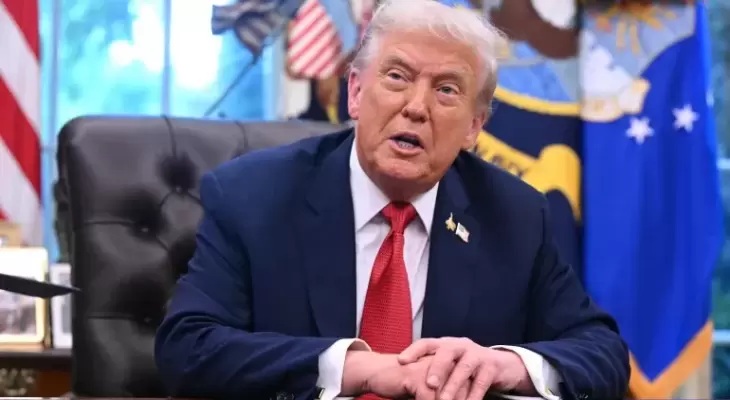
SANAA, April 07 (YPA) – The US-Iranian confrontation has entered its most perilous turning point in modern history, as the rhetoric shifts from “maximum pressure” to explicit threats of “total annihilation.”
With the deadline set by U.S. President Donald Trump to broker a new deal fast approaching, the pace of statements has escalated, placing the Middle East and the entire world before open scenarios of an unprecedented war—one where military threats intertwine with ambitions for radical political change.
In a post that sent shockwaves internationally via his “Truth Social” platform, President Trump used unprecedented language, describing the current moment as a definitive crossroads in world history. The core of his messages can be summarized as follows:
- The Civilizational Threat: Trump hinted at the end of an “entire civilization” on the night the deadline expires, this Tuesday, noting that this scenario “will likely happen” despite his lack of desire for it.
- Regime Change: He linked the avoidance of catastrophe to a “complete and comprehensive regime change,” betting on the emergence of leaders he described as “smarter and less radical” to bring about a revolutionary transformation.
- The Final Countdown: The U.S. President asserted that 47 years of what he termed “blackmail, corruption, and death” are drawing to a close, concluding his statement with the phrase “God Bless the Iranian People,” in a clear move to decouple the people from their political regime.
Tehran’s Red Lines: The Economic Nerve
Tehran was not slow to draw its red lines. The response came from the “Khatam al-Anbiya Central Headquarters” (the highest military coordination authority in Iran), carrying threats targeting the jugular of the global economy:
- Closure of the Strait: The headquarters spokesperson, Ebrahim Zolfaghari, confirmed that any targeting of Iranian power plants would be followed by a total closure of the Strait, which would not be reopened until reconstruction is complete.
- Symmetric Retaliation: Tehran vowed to strike all power plants within “Israeli occupation areas” as a direct response.
- Regional Escalation: The threat extended to the destruction of all companies in which the United States holds shares in the region and neighboring countries, signaling an expansion of the conflict to include regional allies.
“Operation Epic Fury” vs. The Pakistani Initiative
The world holds its breath for what the coming hours will yield; we are either facing a “revolutionary diplomatic moment” born from the womb of threat, or a military explosion whose shrapnel is unpredictable.
Between Trump’s vow to end a “civilization” and Iran’s threat to shut the “world’s artery,” the old rules of engagement have completely collapsed, replaced by a “bone-breaking” logic in a zero-sum game that could redraw the map of the Middle East forever.
On another front, U.S. Central Command (CENTCOM) posted an image on the “X” platform of a B-2 Spirit stealth bomber, accompanied by a caption indicating readiness to execute a mission within what it called “Operation Epic Fury” against Iran. This move reflects the nearing execution of potential military strikes.
“U.S. Air Force crew chiefs conducting final technical checks on a B-2 Spirit stealth bomber, in preparation for a mission under Operation Epic Fury,” CENTCOM stated on Tuesday, signaling the Air Force’s readiness for offensive operations.
In parallel with this escalation, “The Wall Street Journal” newspaper reported that Turkey, Egypt, and Pakistan are intensifying diplomatic efforts to push Iran and the United States toward the negotiating table, aiming for a ceasefire or the containment of the worsening military escalation.
The Pakistani Proposal: A Two-Stage Rescue
At the heart of this hurricane, Pakistani mediation emerges as the final diplomatic thread preventing a slide into total confrontation. Islamabad, led by Army Chief Field Marshal Asim Munir and in coordination with regional powers (Egypt and Turkey), presented a two-stage emergency initiative:
- Phase One: An immediate and comprehensive cessation of hostilities for 45 days, during which maritime corridors (Strait of Hormuz) are opened and mutual attacks cease.
- Phase Two: Entering direct negotiations aimed at a “Comprehensive Deal” covering the nuclear file, sanctions, and regional roles—the very “grand diplomatic victory” Trump aspires to achieve.
The Final Hurdle: The Timing
The primary obstacle now is timing. President Trump, following his rigid logic, set a deadline ending tonight (April 7, 2026) to reach an agreement, threatening to target Iranian “infrastructure and power plants.”
Meanwhile, Tehran informed the Pakistani mediator of its rejection of “deadlines” under the pressure of threats, maintaining that any ceasefire must be part of a permanent end to the war, not merely a “warrior’s break.”
Between the Iranian response and the American stance, we face two possible paths in the next few hours:
- Scenario One: Both parties accept the “Pakistani Plan” at the last moment as a political cover to save face; Trump boasts of imposing his will, while Iran catches its breath and de-escalates the siege on its oil artery.
- Scenario Two: The mediation fails due to the “psychological gap” between the two sides, leading Trump to execute his threat of surgical strikes on infrastructure, met by an Iranian retaliation in the Strait of Hormuz.
YPA