
Bodies of dead reveal hidden face of explosive conflict in Hadramout
HADRAMOUT, Dec. 29 (YPA) – After days of being out in the open, three ambulances equipped with specialized medical personnel from the Al-Shehr district of Hadramout, accompanied by leaders of the militants of the UAE-backed Southern Transitional Council (STC), moved towards the “Khurd” area to retrieve the bodies of dead from the security support factions, who have been killed during the recent confrontations with the gunmen of the Saudi-backed Hadramout Tribal Alliance (HTA)
The scene of the delayed recovery, which came three days later, was not a passing detail, but a window revealing a deeper shift in the power equation in eastern Yemen.
Air strikes and shifting lines of contact
According to identical local and security sources, these developments came after air strikes attributed to Saudi fighter jets targeting positions of STC’s factions, in the vicinity of the Hadrami coast and areas in the Hadramout.
It is noteworthy that the Saudi strikes-if their circumstances were confirmed-did not target groups hostile to the Saudi-led coalition, but forces calculated on one of its parties, reflecting an unprecedented rift within the structure of the coalition itself.
According to the same sources, the bodies have been lying in the open for several days, in a scene that has aroused resentment and concern among the population, especially with the escalation of humanitarian and health concerns resulting from leaving the dead without recovery or burial, in light of the tense security atmosphere and the lack of any clear field arrangements during the past days.
Delay raises questions
The sources pointed out that the delay in the recovery operation came as a result of the continuing tension in the area, and the absence of safe field understandings that allow the arrival of medical teams, amid fears of renewed clashes or targeting crews during their movement.
Despite the ambulance movement, no official data has been issued at the moment of preparing this report to clarify the exact number of dead, the circumstances of the delayed recovery operation, or the subsequent steps related to the delivery and burial of bodies.
Riyadh-Abu Dhabi conflict: from partnership to rivalry
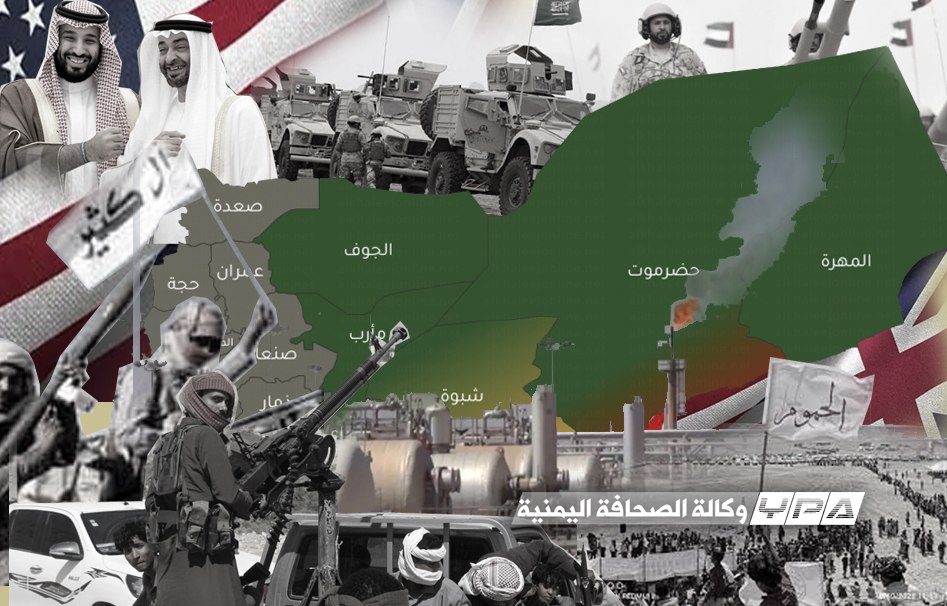
Despite the declared partnership between Saudi Arabia and the UAE in Yemen, field developments have revealed open competition for oil and gas riches and strategic locations in the eastern Yemeni provinces, especially Hadramout, Mahra and Shabwa.
While Riyadh seeks to consolidate its influence and open an oil corridor from Hadramout to the Gulf of Aden through direct security arrangements, Abu Dhabi sees the “STC” and its armed arms as a strategic tool to control ports and energy lines.
The Saudi air strikes put this rivalry in the category of indirect confrontation, rather than just managing differences behind the scenes.
Abdullah Abuhadi, a top former official in Hadramout, said in a special statement to the Yemeni Press Agency that the UAE planned from the first days to control strategic ports and islands, ports and sources of Yemen’s sovereign wealth, through the militarization and militarization of armed factions, starting from the fire belts and Security Support forces to the forces of the southern giants in order to control the Yemeni coasts, while Saudi Arabia delayed for unknown reasons to be surprised that the UAE began to crawl and control the oil areas.
“The recent Saudi move and awakening came after the UAE took control of all the southern and eastern Yemeni provinces,” he added.
Why did Hadhramaut?
Hadramout is the largest Yemeni province by area, the richest in oil and gas, land and sea ports, and represents a strategic economic artery for any power seeking to arrange long-term influence in the east of the country.
Analyses indicated that the clashes between the security support of one of the factions of the STC and the HTA were only one of the manifestations of the redrawing of influence for the regional countries represented by the UAE and Saudi Arabia, where local tribal forces refuse to extend armed formations outside the Hadramout consensus, in exchange for efforts to impose a security fait accompli by force of arms in favor of factions affiliated with the UAE that call for the division of Yemen.
Unanswered outstanding questions
Despite the seriousness of the scene, the official silence of the STC is clouded by the reasons for the delay in the recovery of the bodies for days?
Was the area unsafe only because of clashes,or as a result of possible air strikes?
Who owns the decision of peace and war in Hadramaut: the local authority or the regional powers?
Is the governorate turning into an arena of settling scores between yesterday’s allies?
Humanitarian and security dimensions
Local residents believe that leaving the bodies in the open for days reflects the fragility of the security situation, the lack of coordination between the conflicting parties, in addition to the decline of humanitarian considerations in front of military and political calculations.
While the local community is waiting for the results of this process, the official silence still is prevailed, in light of popular demands that humanitarian and medical work should be neutralized from the conflict and ensure respect for human values, regardless of the nature of the existing differences.
Residents also warned of the repercussions of such scenes on the social peace in Hadramout, stressing that continued escalation may open the door to more violence and tribal divisions in one of the most sensitive and relatively stable Yemeni governorates over the past years.
The human cost of conflict of interests
Beyond the maps of influence, civilians are paying the price: the disruption of daily life, constant fear, and the erosion of community confidence in any security arrangements imposed by force.
Abu Hadi said: “The continuation of this approach portends a social explosion in a province historically known for its cohesion, peace and distance from partisan and military conflicts from the independence of South Yemen from British colonialism on November 30, 1969, and may push wider tribal forces into open confrontation“.
What happened in the “Khurd” region of Hadramout couldn’t be separated from a silent regional struggle over the riches of the Yemeni East. The recovery of the bodies was the final chapter of a larger scene.
When the oil-rich provinces turn into arenas of bloody conflict between arms partners… The corpses become the first evidence, the ruin of cities and the tearing of their social cohesion end sadly.
UAE: the link between the entity and East Africa
The Saudi airstrikes came a day after the “Israeli” recognized Somaliland as an independent state.
According to Hebrew reports, the Israeli recognition received direct Emirati support. Abu Dhabi has a wide military and economic influence in “Somaliland”, through the Berbera military base, which includes a military port and a runway for fighter jets and transport aircraft.
The Hebrew newspaper “Walla” indicated that this base formed part of the logistical structure of the military campaign led by the UAE and Saudi Arabia in Yemen, especially in support of southern separatist forces, which makes it a pivotal element in any future security arrangements related to Yemen, and also makes it a junction point between the two files: the Horn of Africa and Yemen.
AA