
Race to control Bab al-Mandab unites Israeli occupation, UAE-backed STC against Sanaa
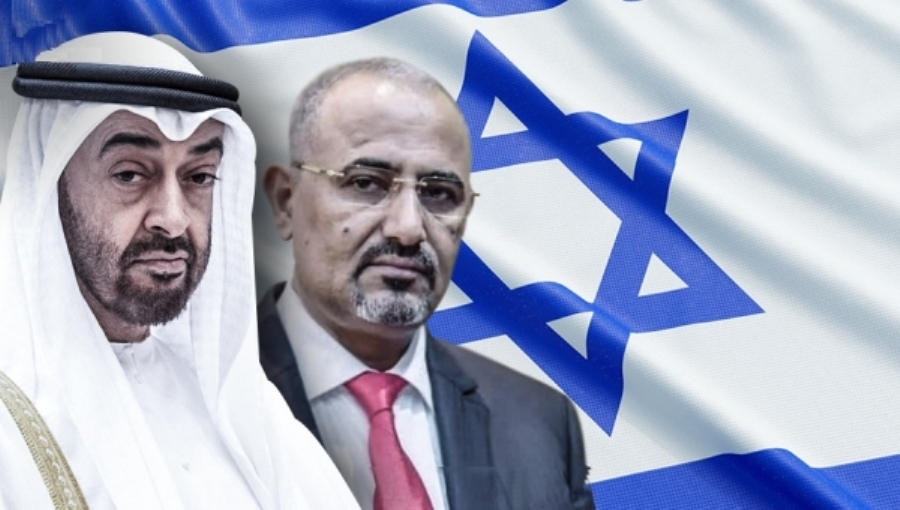
SANAA, Dec. 16 (YPA) – The recent period has witnessed an increasing rapprochement between the UAE-backed Southern Transitional Council (STC) in Yemen and the Israeli occupation, a notable development in the regional political landscape and its shifts, driven by mutual security and political interests.
The STC, which is funded by the UAE, seeks to portray itself as a partner aiming to secure maritime passages, with the goal of gaining international support. This support would serve several interests, including providing protection for the Israeli entity and securing its recognition before officially declaring secession from northern Yemen.
In February, Aidarous al-Zubaidi, the head of the STC, stated during a television interview with RT that “normalization with Israel is a potential matter when we have a state and a capital belonging to South Arabia.” He clarified that the so-called “Southern Transitional Council” had blessed the normalization of relations between some countries and “Israel.” He stressed that if they become a sovereign state with Aden as its capital, it would be their sovereign right to propose normalization with “Israel,” as he described it.
Shared Strategic Interests
For the Israeli occupation, the Red Sea and the Bab al-Mandab Strait are vital, connecting it to Asia and the Indian Ocean. Therefore, Tel Aviv considered the support provided by Sanaa forces to Gaza—by striking Israeli or Israeli-affiliated vessels—as detrimental to its national security. Consequently, they moved to form an alliance with STC forces to halt Ansarallah’s attacks in the Red and Arabian Seas, under the guise of international recognition of the STC and the imposition of its sovereignty over the South.
In early November 2023, the STC leadership sent a solidarity message to the Israeli occupation, announcing the Council’s readiness to protect “Tel Aviv’s” interests in the Gulf of Aden and the Arabian Sea by escorting its ships and using its forces for protection. The STC stated in a communiqué that it declares its constant readiness to work on what it called “deterring the behavior of the Houthis in Bab al-Mandab, the Red Sea, the Arabian Sea, and the Gulf of Aden,” in an implicit reference to the operations targeting Israeli ships in response to the occupation’s crimes in Gaza. The STC conditioned its support on the occupation, the U.S., Saudi Arabia, and the UAE “raising and developing the readiness of its naval forces,” according to the statement.
Covert Diplomacy and Strategic Shifts
Recently, the British newspaper “The Times” revealed that secret talks took place between representatives dispatched by the UAE-aligned STC and “Israeli” officials—a step observers described as a hidden strategic shift in the region.
The British newspaper reported that the rapprochement between the two parties is based on what it called a “common cause”: confronting the Sanaa forces, which have carried out military operations with missiles and drones against the occupation over the past two years, since the Al-Aqsa Flood operation in 2023.
The economic collapse that the occupation suffered and continues to suffer due to the Yemeni strikes on its ships and occupied ports significantly affected “Israel.” The Russian newspaper “Nezavisimaya” confirmed the existence of “Emirati-American efforts to arm the STC factions, so that the latter can confront Sanaa forces and limit their control over the sea.”
The newspaper explained that the Pentagon may equip the Southern Transitional Council and Tariq Saleh’s forces with weapons to help stop Ansarallah’s movements in the Bab al-Mandab Strait. Media sources subsequently revealed secret meetings in August 2023 between STC leaders, represented by Socotra Governor Raafat al-Thaqali, and Israeli diplomats and military officials in the UAE capital, Abu Dhabi.
In September of this year, the Hebrew newspaper “The Jerusalem Post” revealed that an Israeli journalist visited the city of Aden, the seat of the pro-Saudi-led coalition government, as part of a Middle East Forum delegation. The Israeli newspaper mentioned that the visit was arranged and supervised by the Southern Transitional Council, where the delegation was received at the headquarters of ‘the National Southern Media Authority’ in the presence of Mukhtar al-Yafei and several STC leaders.
Israeli Strategy and Regional Power Dynamics
The Israeli occupation realizes that controlling maritime passages means controlling a key power card in the region. As noted in a 2022 paper by the Middle East Institute in Washington, “The Red Sea has become a central axis in Israeli strategy, with new security alliances being built to ensure the security of navigation and trade from the Suez Canal to Bab al-Mandab, while considering Yemen both a threat and an opportunity.”
The military movements led by the STC in southern and eastern Yemen have been described by Zionist research institutes as developments that serve the occupation’s strategic interests in reshaping the balance of power around the Red Sea.
According to a report by ‘the Israeli Institute for National Security Studies,’ the STC forces’ control over Hadramout governorate is evidence of the collapse of the traditional Saudi-Emirati coalition, where internal conflicts have led to the disintegration of the anti-Sanaa camp.
From an “Israeli” perspective, the report views the “golden opportunity” as the emergence of a pro-UAE entity positioned near the Bab al-Mandab Strait, which could help curb the hostile Yemeni maritime influence on Israeli navigation in one of the world’s most important waterways. The newspaper “Israel Hayom” reported on talks that included demands from the STC to obtain advanced weapons to confront Sanaa forces.
Deepening Collaboration and Military Implications
Reinforcing this STC-led trend, prominent Israeli geopolitical expert Avi Avidan stated in a post on his X page that the STC’s actions are part of the genius created by the UAE with its “pincer strategy” with “Israel.” He explained that this pincer aims to “outmaneuver Sanaa forces at every turn,” starting from the strategic Socotra Island, which contains joint intelligence centers between the UAE and “Israel,” extending to Aden, and now reaching the vast area of Hadramout.
The normalization of relations between the UAE and the Israeli occupation in 2020 was widely welcomed by the STC’s vice-president, Hani bin Breik, indicating an early alignment with the Israeli normalization agenda in Abu Dhabi. A year later, Al-Zubaidi praised the normalization agreements with the UAE, Bahrain, Sudan, and Morocco, and expressed readiness to normalize with the occupation.
An analysis by ‘the Arab Center Washington DC’ touched upon the plans of the UAE and the Israeli occupation, which included building a military facility on the Yemeni island of Socotra. In 2021, the UAE began transferring dozens of Israeli officers and soldiers to Socotra. Nine months later, the U.S. Naval Forces Central Command conducted a naval exercise in the Red Sea with Bahrain, the UAE, and the Israeli occupation—the first publicly confirmed military cooperation between the normalization agreement partners.
The movements of the STC factions in southern and eastern Yemen came at an Emirati instigation, backed by Israeli directives that are no longer covert. With the occupation’s escalation in occupied Palestine, the Sanaa forces took a supportive stance, conditional on the cessation of aggression against Gaza. The intervention of the Sanaa forces, with such speed and response, was seemingly not factored into Israeli and American calculations, or at least the Zionist entity expected the intervention to be limited and ineffective at best. What the Sanaa operations achieved in support of Gaza was surprising in both military and political realities, prompting the Israeli enemy to reconsider activating its relations with the UAE, which manages and financially supports the STC.
The Israeli orientation led the UAE to deploy Israeli military experts to Socotra Island, as revealed by the international website “Var News.” The website reported that the Israeli delegates, believed to be technical experts affiliated with the Israeli occupation navy, possess numerous devices and equipment and are conducting research and excavation in different parts of the island.
The French-language news channel JForum reported in August 2020 that “Israel, in cooperation with the UAE, planned to build intelligence-gathering bases on Socotra Island.”
Furthermore, the company “Planet Labs” revealed satellite images showing the completion of an “unknown” runway on Abd al-Kuri Island, one of the islands of the Yemeni Socotra Archipelago, which could provide a central area for military operations patrolling the area, as well as for commercial shipping through the Gulf of Aden and the Red Sea. According to reports, the runway was built by the UAE, which has been trying to expand its military presence in the region for many years.
YPA