

Al-Barakani’s Aden visit: Not to bridge the rift, but to legitimize secession
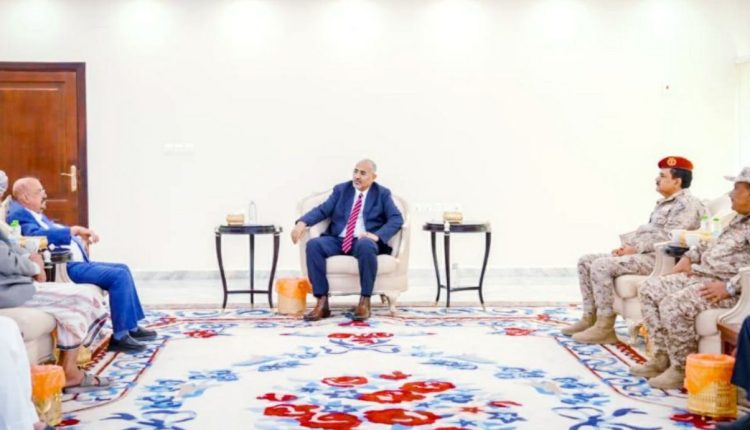
ADEN, Dec. 16 (YPA) -The recent visit by Sultan Al-Barakani, appointed Speaker of the Parliament loyal to the Saudi-led Coalition, to Aden was an attempt to “bridge the rift” within the Coalition-backed “legitimacy” camp in Yemen, as it is being portrayed in the media. Rather, it took place in a completely different political context, which can be interpreted as an advanced step toward the undeclared legitimization of secession.
The visit, by its timing, location, and symbolic arrangements, was not aimed at rearranging the status of the so-called “legitimacy” on the basis of a unified Yemeni state, but rather worked to adapt it to the existing reality on the ground.
The timing of the visit clearly reveals its true objective, as it came after Saudi Arabia and the UAE enabled the UAE-backed “Southern Transitional Council” (STC) to impose effective control over the southern and eastern governorates of Yemen, following the marginalization of all military and security forces affiliated with the so-called “legitimacy,” particularly in Hadramout and Mahra.
This timing cannot be separated from the logic of a ‘post-rearrangement of the situation’ phase, shifting the military conflict management to its political re-articulation. This ensures the consolidation of results on the ground and grants them official cover, without the need to directly announce secession, which could entail political, regional, and international costs at the present time.
The choice of Ma’ashiq Palace as the venue for Al-Barakani’s meeting with Aidarous Al-Zubaidi carries a deep sovereign implication. The palace, which according to the discourse of the Coalition-backed “legitimacy” is supposed to be the symbol of the Yemeni state’s authority, was transformed in this scene into a platform for practical recognition of a parallel authority acting as a de facto government in the South.
The meaning becomes clearer when the Speaker of the so-called Parliament (supposedly the highest formal legislative authority) is received by the head of the STC at this specific location. This signifies that the so-called “legitimacy” is no longer dealing with the STC as an entity within its framework, but as an established authority with which the relationship is being redefined based on what the Saudi and Emirati sides see fit, not on the basis of state unity.
This trend is reinforced by the absence of the flag of the Republic of Yemen from the meeting—an absence that cannot be dismissed as a mere protocol oversight.
In politics, symbols precede texts. The absence of the Yemeni flag reflects an implicit acceptance that this meeting took place outside the framework of the single state. It expresses a symbolic division of Yemen, which aligns perfectly with the project of practical separation without a formal declaration.
Furthermore, the presence of high-ranking military and security figures affiliated with the Coalition-backed government—from the Minister of Defense to the Advisor for Security and Defense Affairs and military regions’ commanders—lends an institutional dimension to this trajectory that cannot be ignored. The military establishment, which is supposed to be responsible for preserving unity, appeared in this meeting as part of the process of granting political cover to a secessionist entity: the “Southern Transitional Council.”
This allows the STC to manage the southern and eastern governorates of Yemen militarily and securely, in exchange for confining the role of the so-called “legitimacy” to a limited external function: nominal representation of the Yemeni state to the international community, without possessing actual authority on the ground.
In this context, Sultan Al-Barakani’s visit to Aden can only be understood as a step within an undeclared deal. This deal is based on empowering the STC to completely manage the southern and eastern governorates of Yemen politically and securely, in exchange for maintaining the “legitimacy” as a fragile diplomatic cover in international forums. This cover is not intended to govern or manage, but to postpone fundamental questions related to secession until a more regionally and internationally opportune moment.
Consequently, this visit does not represent a mere fleeting political event, but rather lays the foundation for the practical legitimization of secession, viewed as a temporary status imposed by the necessities of the phase.
This will persist until both the UAE and Saudi Arabia determine that the political cost of officially announcing secession has become less than the cost of maintaining this grey status. At that point, the declaration will be nothing more than the culmination of a long-started process, and Sultan Al-Barakani’s visit to Aden was one of its most obvious and significant stations.
@E.Y.M