

38 Years Since Founding of Hamas: From Womb of Intifada to Pivotal Actor in Conflict Equation
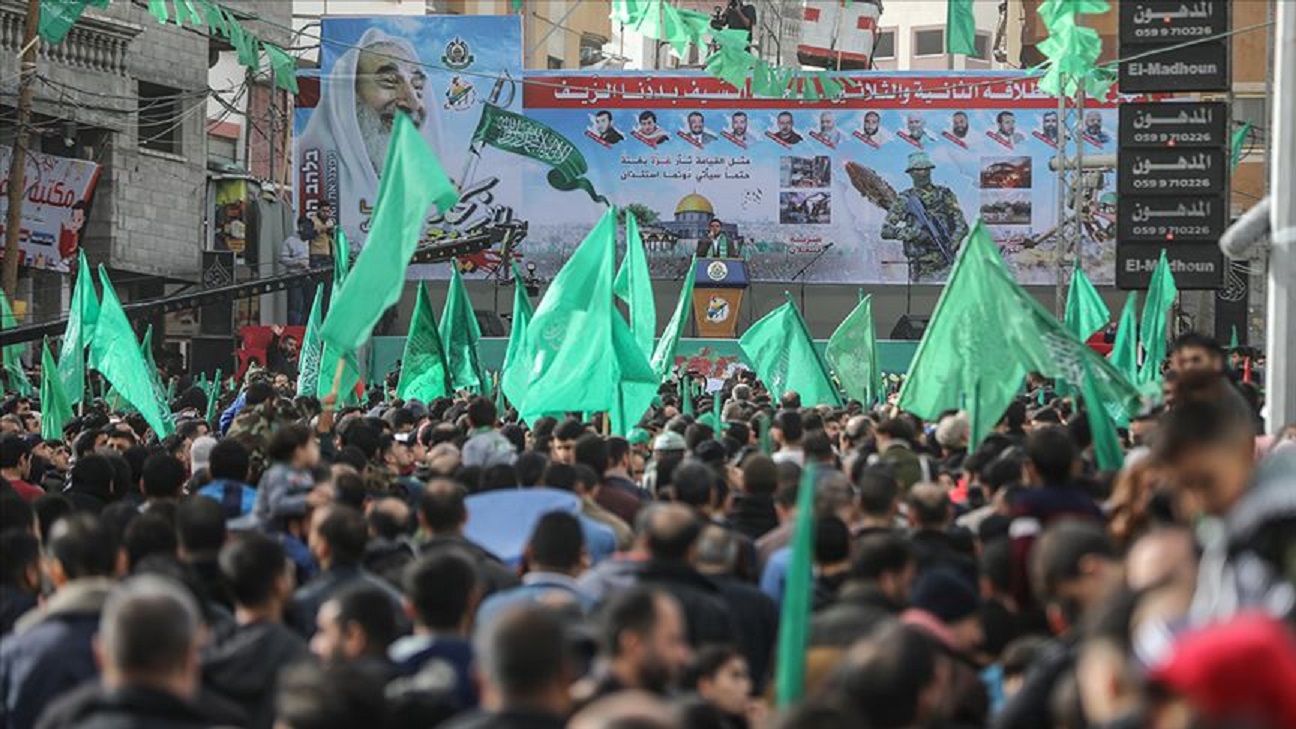
GAZA, Dec. 16 (YPA) – The founding of the Islamic Resistance Movement “Hamas” in late 1987 occurred within an immensely complex political and social context. This period was characterized by a political deadlock for the Palestinian people, a long accumulation of oppression, escalating Zionist settlement expansion, and the declining ability of traditional national frameworks to contain popular anger.
In this climate—marked by the erosion of the national project and escalating violations against the land and its people—the movement’s emergence was not a mere ideological act, but rather a response highlighting the need for a new organizational framework to reshape Palestinian action, merging religious identity with a national dimension.
From its inception, Hamas was distinguished by its attempt to bridge two references: the Islamic and the national. This synthesis was not easy in a Palestinian arena crowded with various currents, yet it granted the movement the ability to appeal to broad social segments, particularly in refugee camps and marginalized environments.
The question that imposes itself after 38 years is: How did “Hamas” transform from a missionary-social project into one of the most influential actors in the Palestinian resistance against the Israeli occupation?
Palestinian journalist Mohammed Shahin said in an interview with the Yemen Press Agency, “The Hamas movement is not merely a transient reaction to the reality of occupation; rather, it is a living expression of the will of a people who chose to confront oppression with steadfastness and aggression with dignity.”
Regarding the historical and struggle-based context, Shahin stated, “Hamas emerges as a national liberation movement practicing its struggle within the bounds guaranteed by international law for peoples under occupation, as stipulated by the Geneva Conventions and UN Charters, which grant the right to resist occupation in all forms, including armed struggle.”
Shahin added, “Hamas and the Palestinian people believe that no nation has attained its freedom without offering from its blood that which bears witness to the sincerity of its claim. Hamas is not a party competing for authority, but a movement of creed and struggle; its legitimacy comes from the squares of the martyrs, not from the corridors of politics. Those who march toward death without fear do not do so out of greed for gain, but out of a belief that freedom is not granted, but seized. When a nation chooses to be besieged rather than compromise, to fight rather than comply, it has charted the path to victory, no matter how long it takes or how severe the siege becomes.”
Sheikh Ahmed Yassin: The Leader Who Founded the Idea Before the Organization
Testimonies from researchers and those close to the movement indicate that Sheikh Ahmed Yassin was presented not so much as a field commander, but as an intellectual and organizational architect. He did not just establish an organization in the functional sense; he established a vision of resistance. In the founding years, he focused on building a cohesive social base through charitable and missionary work before engaging directly in confrontation.
A man physically paralyzed but politically and intellectually present, he succeeded in transforming popular anger into an organized project based on societal mobilization prior to military action.
Yassin relied on three pillars: popular rootedness through mosques and charitable work; the redefinition of resistance as both a right and a duty; and investment in the youth as the lever of the future.
His assassination in 2004 marked a pivotal turning point, yet it did not end the project; instead, it reproduced it with a more diversified leadership.
Founding as a Result, Not a Choice
Estimates from researchers in Palestinian affairs indicate that more than 60% of Palestinians in Gaza and the West Bank at that time were under the age of 25. This demographic felt a lack of political representation, providing a fertile environment for the emergence of a new organization to reshape national action from the grassroots.
The Shift to Armed Resistance: Necessity or Choice?
With the outbreak of the First Intifada, “Hamas” gradually shifted from social action to resistance work—a move that can be interpreted as a response to street pressure as much as an organizational decision.
Human rights data indicates that this stage was accompanied by:
A broad escalation by the Israeli occupation involving assassinations and arrests, during which thousands of the movement’s cadres were detained within a single decade, and most of the first-tier leadership was assassinated between 2001 and 2004.
Martyrs and Legitimacy: Numbers That Speak
In Hamas’s discourse, legitimacy was not derived solely from elections, but from the field. Human sacrifices and the expansion of resistance work contributed to solidifying its image as a movement that “pays the price” and does not settle for mere slogans.
According to Palestinian statistics:
The movement lost hundreds of its leaders and cadres during the two Intifadas. Its members constituted a significant percentage of the total martyrs during major periods of escalation, and political assassination became a structural element in its conflict with the occupation.
This reality bolstered its image as a movement that “pays the price,” but simultaneously raised the cost of political action and increasingly linked its legitimacy to confronting the occupation and its crimes.
Mohammed Shahin says: “What Hamas has offered—through its leadership, soldiers, and people in Gaza—is not only an epic of steadfastness but a shift in the equations of power. A people that is besieged and bombed, yet rises from under the rubble to fight, cannot be defeated. I can almost see on the horizon that victory will not come from negotiation palaces, but from the alleys of Gaza and from the hands of its unyielding men.”
He added, “Since its founding, the movement has provided a living model of steadfastness and sacrifice, offering hundreds of martyrs from its leaders and cadres in a long journey of confrontation, during which it never abandoned the option of resistance despite all pressures. Through the two Intifadas and the repeated wars on Gaza, Hamas has proven that the cost of steadfastness is far less than the price of relinquishing rights and principles.”
The 2006 Elections: Peak Moment and Test
With the rise of Ismail Haniyeh, the movement entered a new stage defined by the balance between resistance and governance. Participation in the 2006 elections was not a fleeting decision, but a strategic choice that placed Hamas at the heart of the Palestinian political system.
Hamas’s victory in the 2006 legislative elections—winning 74 out of 132 seats—was not just an electoral event, but a political earthquake. It was followed by: an international financial and political siege, the freezing of hundreds of millions of dollars in aid, and institutional paralysis that directly impacted citizens’ lives, leading to internal friction and a difficult test between the requirements of authority and the principles of resistance.
Despite this, it maintained its presence, relying on the discourse of popular legitimacy and the rejection of external dictates.
Shahin says: “Hamas’s victory in the 2006 elections represented a transition from the category of resistance alone to a new equation: political governance and resistance together. Despite the siege, sanctions, and challenges, it managed to maintain a difficult balance, supported by popular and field legitimacy.”
After 38 Years… What Remains of the Initial Idea?
Today, after nearly four decades, “Hamas” is no longer just an emerging movement, but rather: an influential regional actor, a difficult factor in any settlement, and a model viewed with respect in various parts of the world. The movement has succeeded in establishing an equation stating that the Palestinian cause has not been closed and that attempts to erase identity have not succeeded.
A Movement That Resembles Its People
The story of Hamas is, in essence, the story of a people who did not accept final defeat and did not submit to injustice. They offered sacrifices and watered the land with blood for liberation and dignity.
It is a movement that has changed and been subjected to the most horrific wars of genocide, yet remains connected to its primary root: an Arab Palestine that will not accept partition or occupation, and a belief that Palestine will remain alive and rooted in the memory of history.
In conclusion, the journey of Hamas shows that movements born from the womb of crises carry within them existential causes. It is a movement that resisted and stood firm, governed and was drained, and was besieged by a context larger than itself, yet remained active and influential. It succeeded in bringing the Palestinian cause back into the spotlight after years in which America and the Israeli occupation attempted to obscure it.
YPA