

The American Peace: A Slogan for War and Hegemony
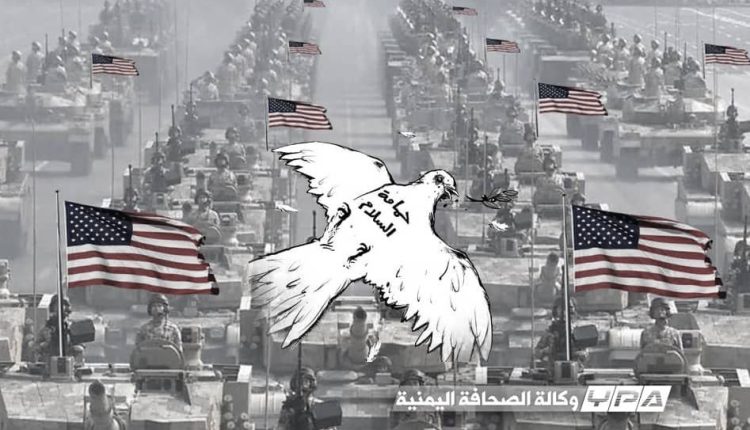
SANAA, Dec. 13 (YPA) -As the United States raises the slogan of ‘Global Peace,’ its decades of intervention reveal the slogan to be not a project for de-escalation, but a political cloak for expanding influence and power.
A nation whose political age has not exceeded 250 years has spent over 93% of its history in wars, invasions, and manufacturing coups, recording more than 90 documented military interventions that have scarred world maps with destruction and debris.
Peace for Consumption… and a Renewed Hegemony Project
Since the 1950s, Washington has projected an image of “peace” and “moral values” through its diplomatic rhetoric, even as its intelligence and military apparatus were simultaneously engaged in assassinations, sabotage, and regime change operations across Asia, Africa, and Latin America.
“Camp David,” “Oslo,” and the “Marshall Plan” are all examples of using peace as a cover for re-engineering balances, breaking up the Arab front, and facilitating Israeli expansion in the region.
“Peace Through Power”… An Old Slogan with a New Face
On January 15 of this year, US President Donald Trump revived the thesis of “Peace Through Power” in the context of his announcement of the ceasefire in Gaza, saying, “We will continue to promote peace through strength in the region, building on the momentum of the ceasefire to expand peace agreements.”
He thus adopted an old philosophy that accompanied the history of imperialist powers, reaching the modern American strategy, which entrenched this approach from “the creation of power” to its decisive use, as happened in World War II.
Observers view his speech as a continuation of an American trajectory based on establishing hegemony by investing in joint movements with “Israel” in regional files, and the threat of force against its adversaries, thereby imposing a “peace” that suits American interests and enhances “Israel’s” presence on the regional scene.
Going back to history, Trump’s thesis of peace through power is the culmination of a long historical path for the evolution of “principles of power” in American strategy over prolonged decades, starting from the principle of “The Art of Creating Power,” as explained by strategy professor Lawrence Freedman in his book A History of Strategy, where he defined it as the art of creating power, a difficult art to master.”
This principle remained prevalent until the beginning of the 1940s, prior to World War II. Following that, the principle of “The Use of Power” was theorized, a principle that culminated in the dropping of the two atomic bombs on the cities of Hiroshima and Nagasaki in Japan during that war (1945), leading to the end of the war and Japan’s surrender. For the Americans, this meant achieving “Peace Through power.”
From the Balkans to Baghdad… Every Time Washington’s Peace Rhetoric Rises, a City Falls
American promises of “comprehensive peace” turned into bombing in the Balkans, and into invasion, occupation, and cross-border chaos in Iraq. Under George W. Bush, the American project was embodied in its clearest form, using “spreading democracy” as a title to invade Afghanistan and Iraq and turn the Middle East into open theaters of violence.
Then came the Trump era, which discarded the pretense of humanitarian intervention. The concept of a ‘peace of national interests’ was officially adopted, and slogans of de-escalation were associated with normalization agreements, such as the Abraham Accords. This diplomatic success was achieved while, on the other hand, the US maintained its firm support as Israeli bombs continued to fall on Palestinians.
The Red Sea: Peace on the Decks of Warships
The current situation in the Red Sea mirrors past patterns. Washington deployed aircraft carriers under the guise of “protecting navigation,” but the true aim is viewed as protecting “Israel” following the naval blockade imposed by Sana’a forces on Israeli shipping routes (Red Sea, Arabian Sea, Bab al-Mandeb, and Indian Ocean) in support of Gaza. Observers suggest the deeper goal is to establish a strategic military presence in this crucial global chokepoint for energy trade connecting Asia, Africa, and Europe.
The Republic of Yemen (Sana’a-led) has been the chief opponent to the “American-Israeli” military presence, demonstrating an exceptional model of military confrontation against attempts to impose a new regional reality, motivated by popular and humanitarian support for Gaza.
Military Impotence and Failure in Peacemaking
The history of the United States is marked by inglorious failures, including the defeat in Vietnam, the collapse of strategy in Afghanistan, and the chaos resulting from the invasion of Iraq.
When the US war machine struggles or faces prolonged attrition, Washington often pivots to the rhetoric of “peace” as a strategic maneuver or a tactical withdrawal, all while continuing to arm the aggressor parties and provide them with political cover.
The American Veto: The Moment the Mask Fell
The US veto against UN ceasefire resolutions on Gaza was a critical juncture that tore away Washington’s diplomatic façade.
By consistently blocking international attempts to stop the conflict, the United States made a clear statement: its geopolitical interests take precedence over global humanitarian and human rights demands. This act effectively transformed the US from a perceived mediator into a direct party to the conflict, resulting in its growing moral isolation on the world stage.
Peace That Ignites Wars
From Gaza to Iraq, and from the Red Sea to Afghanistan, the same image is repeated: “slogans of peace” are publicly raised, while projects of control are executed on the ground.
The United States does not produce solutions so much as it reproduces conflicts, and it does not propose initiatives so much as it uses them to open additional doors of influence.
Ultimately, the facts reveal that the peace Washington promotes is not peace in the true sense, but rather a political tool that is invoked whenever the White House administration needs to justify a military presence or push through a new influence project.
Given the current international transformations and shifting power balances, the question remains open for the region: How much longer will American strategy dictate the terms of war and peace? And when will the word “peace” cease to be used as a cover for recurrent “maps of occupation” imposed by US successive administrations?
@E.Y.M