

Southern Syria in Sayyed al-Houthi’s vision to face Israeli escalation
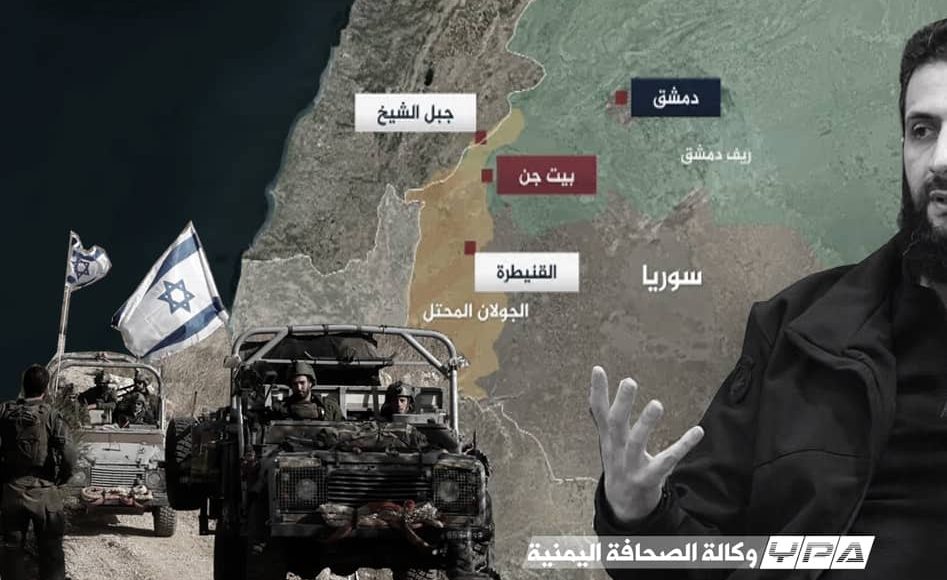
SANAA, Dec. 11 (YP) – Sayyed Abdulmalik Al-Houthi’s speech has intersected with the escalation of “Israeli” incursions and attacks in southern Syria – especially in Quneitra province and areas adjacent to the border strip, with a wider scene of crimes and systematic violations being suffered by Palestinian women during the years of Israeli aggression.
In the regional context
The speech of Abdul Malik al-Houthi, the supreme leader of Ansarallah movement, on Wednesday, on the occasion of the international Muslim women’s day, which coincided with the escalation of tension during the past days on the Syrian border with occupied Palestine, especially in Quneitra countryside, which is a sensitive area subject to strict rules according to disengagement agreements since the seventies of the last century.
Background of the scene in Quneitra
In his speech, Al-Houthi interpreted the “Israeli ” incursions or raids in southern Syria and the countryside of the capital Damascus as part of a plan to redraw the equations of regional control, to open pressure spaces against resistance factions and to try to undermine their presence in the lines of contact.
In recent days, the southern regions of Syria have recorded “Israeli” incursions and attacks inside the dividing strip, in addition to limited clashes near the village of Khan Arnaba, which sparked popular protests in those areas.
According to the testimonies of residents of the village of Khan Arnaba, the residents gathered near one of the “Israeli” checkpoints and demanded his departure, while a large column of the Syrian internal security passed through the checkpoint without a clash or shooting-in a scene highlighting the fragility of the security situation and the complexities of control.
Increased exposure of local residents
The Houthis linked the inability or unwillingness of some local forces (or factions affiliated with the new Syrian regime) to protect the people with the increasing incursions and attacks, which shows an administrative and security failure bearing the responsibility of the “trusted on the ground”.
In the context, local residents in Quneitra revealed on Tuesday that the forces of the interim government and the dominant factions in Quneitra and the countryside of Damascus did not intervene to protect villages from repeated incursions by the Israeli occupation forces, which prompted residents to protests and direct confrontations with the occupation forces in the absence of organized forces that can prevent violations or adjust the lines of contact.
Experts believe that this security vacuum has reopened the file of disengagement rules, especially with the escalation of “Israeli” raids inside Syria, including sovereign centers in the Syrian capital Damascus, without a response from the local controlling forces in Syria.
A model of association with the United States
Al-Houthi linked the reality of Quneitra and the security vacuum there, and what he described as the ”hypocrisy option” of the dominant groups in Syria, accusing those groups of being “associated with the American and not hostile to the Israeli occupation, but seeking a relationship with it despite the raids and occupation.
Senior Ansarallah leader said that this model expressed the image of the deviation that affected part of the nation due to the soft war and the replacement of concepts, considering that the acceptance by some of these groups of the policies of “changing the Middle East” in favor of “full Israeli domination.
Satanic soft war as a field of conflict
Mr. Al-Houthi presented the contemporary conflict in the region as a multi-level conflict, not only militarily but culturally, psychologically and politically with the aim of “dismantling the faith identity” and creating alternative allegiances.
This characterization transforms the traditional conflict into a confrontation with a long-term horizon that is addressed through education, media, politics and economics.
Confrontational speech
While Mr. Abdulmalik al-Houthi has previously held the Israeli occupation and the United States responsible for the strategy of escalating aggression against the countries of the region, he also blamed Arab regimes that he described as”collaborators or complicit” that contribute to the Israeli occupation evading effective legal accountability.
The leader of the Ansar Allah group, Mr. Abdul Malik al-Houthi, believes that the political and diplomatic engagement of some regimes has turned the concept of peace into surrender, and calls for redefining the approach based on resistance and repulsion, not moral coexistence with the occupation.
It seems that Mr. Al-Houthi’s call on the Arab and Islamic nation and regimes to confront the American and”Israeli ” plans and return to the concepts of the Holy Quran may motivate regional actors to re-read their tactical calculations; demanding practical support for the resistance may result in an increase in the exchange of strikes or the movement of regional armed forces.
Sanaa forces have already confronted the American forces in the Red Sea and gave painful blows to the positions of the occupation forces, imposing a naval blockade on the port of Umm al-Rashrash, known as Eilat, after the speech of leader Al-Houthi, who stressed that his country would not leave the Palestinian people for an easy bite under the fangs of enemies, demanding the Israeli occupation to lift the blockade of the Gaza Strip in exchange for lifting the blockade of the ports of Occupied Palestine, and stop the aggression on Gaza in exchange for stopping the rocket strikes and the Yemeni flight towards the occupation sites in Occupied Palestine.
Protection of civilians
Field data in southern Syria has showed that the policies of “Israeli ” violations remain not only limited to the militarization of the contact lines, but also create humanitarian and political waves intersecting with the reported violations against women in Palestine.
This intersection requires an urgent multidimensional response – humanitarian, legal and political – to avoid further deepening the suffering of civilians and women. Independent investigations and the installation of protective mechanisms are the crucial first step towards holding the guilty accountable and securing a minimum of justice for the victims.
From a practical analytical perspective, Sayyed al-Houthi’s speech is in line with humanitarian and legal approaches that focus first on the protection of civilians, especially women, and on accountability mechanisms that reduce the logic of impunity of the Israeli occupation, which deepens the humanitarian crisis and expands the conflict in the region.
AA