
Saudi-led coalition and Hadramout drama represents new step in war on Sanaa
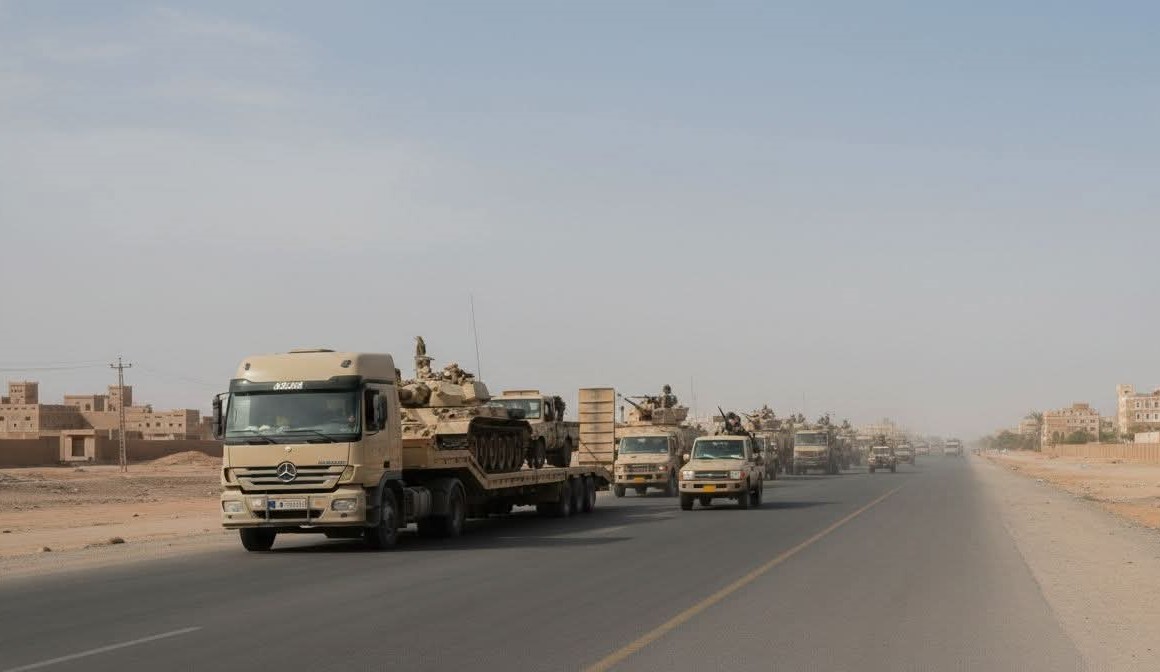
SANAA, Dec. 07 (YPA) – The UAE-funded Southern Transitional Council (STC) forces’ control over the command camps of the First Military Region in Hadramout governorate, as well as over the camps of the Al-Ghaydah axis in Mahra, comes in the form of a handover and takeover charade, within the American, British and Israeli arrangements to launch a new round of war on Sanaa.
The tragedy of the fall of the First Military Region camps, affiliated with Islah Party, with all their equipment and supplies, without any resistance, is repeating itself. This comes after the southern political and military elites loyal to the UAE refused to participate in any new round of the war on Sanaa, except after extending their control over all the southern and eastern governorates of Yemen under the control of the Saudi-led coalition, under the name of “restoring the southern state.”
This is especially true given the continued threats by the leaders of the STC to normalize relations with the Israeli enemy in exchange for recognition of the secessionist project sponsored by Abu Dhabi. Thus, the takeover of the First Military Region camps and the evacuation of Hadramout valley from forces loyal to Islah Party were among the arrangements made by the US Ambassador to the pro-coalition government, Steven Fagin, during September and October of last year, with members of the “Presidential Leadership Council,” the government, and military leaders affiliated with the coalition, including the pro-coalition Minister of Defense, Mohsen al-Daari, who was recently summoned to the UAE to finalize the end of Islah party’s influence in those areas rich in oil and mineral resources. It seems that the Islah party was the last to know about the agreement, through the orders to hand over the camps.
The UAE-funded STC factions were directed, in coordination with the Saudi-backed forces command present in Sayoun, to move suddenly towards Hadramout, coinciding with the announcement by the head of the Hadramout Tribal Alliance, Amr bin Habrish Al-Alii, of an escalation by imposing prior control over the PetroMasila oil company, at the behest of Saudi Arabia, to be a pressure card to ensure the progress of the plan agreed upon in advance with Riyadh, otherwise Saudi Arabia would not have allowed the UAE factions to move all at once from Dhalea, Lahj, Aden, Abyan and Shabwa governorates, especially that Saudi Arabia had been preventing any UAE movements towards Hadramout valley since the announcement of Operation “Siham Al-Sharq” (Arrows of the East) in August 2022, and the UAE’s control over the Islah party camps in Shabwa and their gathering in the Arin camp in the Arma district, which was recently taken over by the “Shabwa Defense Forces” loyal to the UAE, at the same time as taking over the camps of the First Region in Sayoun.
Consequently, the new military and security arrangements in Hadramout and Mahra were implemented according to the agreed-upon plan, especially given the decline of Saudi influence in those areas. Their presence is now limited to Salafist factions of the “Dera Al-Watan” (Homeland Shield) in parts of the Hadramout valley and the desert along the Al-Wadi’ah border crossing, as well as in Mahra since the beginning of 2025. Furthermore, the Saudi-backed “Hadramout Protection” factions, established at the end of July, led by the head of the Tribal Alliance, Bin Habrish. This confirms that Riyadh no longer relies on the STC forces in the First Military Region, which were under the control of factions affiliated with Islah party.
It is likely that the STC forces affiliated with Islah party will be deployed and assembled in Marib, which also includes the Third, Sixth, and Seventh Military Regions, to engage in the Marib fronts against Sanaa forces, before being transformed into a mere transit point for UAE-backed forces from the so-called “Giants of Saba” led by Abdul Hadi Abdul Latif al-Qibli Nimran, one of Tariq Afash’s henchmen, and overseen by Saghir bin Aziz, whom the UAE appointed as Chief of Staff, and who resides in Marib.
Despite the series of blows that the Islah Party has suffered since the UAE-backed factions took control of Aden in August 2019, and the subsequent events in Abyan, including the Al-Alam massacre, the expulsion of its forces from Socotra in June 2022, the ousting of the Islah party-affiliated governor of Shabwa, Mohammed Saleh bin Adyo, and the takeover of the party’s camps in the Ataq axis during August 2022, but the party has not learned its lesson.
Islah party leaders continue to cling to a nominal presence in the pro-coalition “Leadership Council” and the “government,” while its losses continue to mount to the point where the party may find itself ostracized and excluded from the regional and international political game in the coming period.
The coalition countries have worked to corner the Islah Party in the city of Marib, gradually stripping it of its resources, leaving it with nothing but media maneuvering. Meanwhile, predictions indicate that the party’s leadership may completely surrender and hand itself over to Tariq Afash, who, through the STC, is waging a quiet war of revenge to disempower the party leaders who supported the 2011 revolution. They have no choice but to await the worst in the coming days, especially given the limited presence of their party, religious, and media figures on Yemeni territories.
In general, the political and military game of the coalition over the past ten years has been a noose tightening around Islah party’s neck, preparing it for a humiliating mass burial in the sands of Marib and the transfer of the aging bodies of its leaders to Turkish cemeteries.
However, some expect that the Islah Party leadership will carry out retaliatory maneuvers in the coming days against its local partners loyal to the UAE through terrorist operations in Hadramout, and escalation in Shabwa, Abyan, Marib, and the rural areas of Taiz Governorate, especially after the al-Wadi district in Marib became home to training camps for al-Qaeda and ISIS elements. These elements have taken over the Al-Samda area as a headquarters for terrorist leaders who fled the districts of Bayda after they were cleared by Sanaa forces during 2020.
This is coupled with the continued supply of terrorist elements to Modiyah in Abyan and Al-Musayni’ah in the Shabwa highlands, in implementation of the threats made by the head of the Islah Party, Muhammad Abdullah Al-Yadoumi, in mid-September 2022, regarding long-term confrontations stemming from tribal vendettas. This came a month after the party’s camps fell into the hands of UAE-backed factions in Shabwa.