

With hundreds of thousands of victims in the background: did the UN Envoy’s statement do justice to Yemen’s tragedy?
SANAA, Sept. 08 (YPA) – The statement issued on Monday by the UN Special Envoy to Yemen, Hans Grundberg, regarding the recent escalation, has raised questions and criticism over the balance of the UN discourse in framing the Yemeni crisis.
This is particularly notable when current developments are viewed within the context of a war spanning over a decade, rather than as a crisis that began with the recent Saudi attacks and Riyadh’s insistence on maintaining the blockade on Yemen.
In his latest statement, Grundberg warned that “Ansarallah attacks in some areas and the Red Sea could push Yemen back toward a full-scale war,” calling on all parties to “de-escalate and adhere to international humanitarian law,” as he put it.
However, the dilemma lies in a fundamental question: What about the historical responsibility for the war, destruction, and blockade that Yemen has endured?
It is difficult to read the current Yemeni landscape in isolation from the war that broke out on a large scale in 2015, when Saudi Arabia militarily intervened in Yemen.
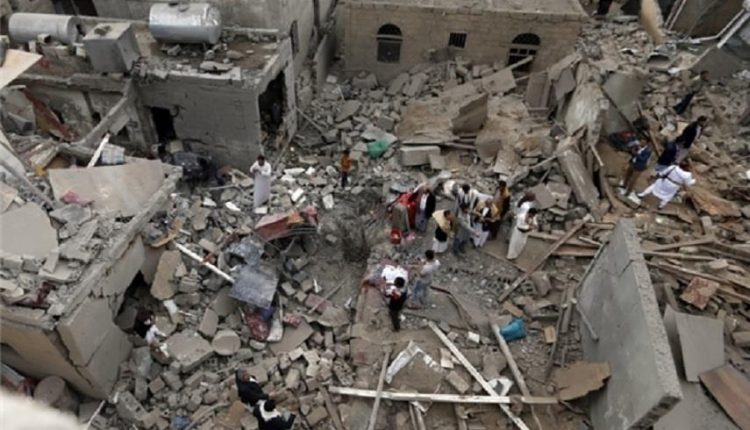
There is no dispute that Yemenis have paid a staggering price over the years of war. According to UNDP estimates, the war was directly and indirectly responsible for the deaths of 377,000 people by the end of 2021—whether through direct targeting of civilians or as a consequence of the war’s fallout, such as hunger, disease, and the collapse of services.
Regarding the blockade that continues to this day, the Group of Eminent Experts—whose mission in Yemen was terminated due to Saudi efforts—concluded that restrictions imposed by the Saudi-led coalition, including the de facto naval blockade and the closure of Sanaa Airport, severely restricted imports and hindered the delivery of aid. These measures contributed significantly to the deterioration of the Yemeni economy, effectively amounting to collective punishment prohibited under international humanitarian law.
In his recent briefings to the UN Security Council on Yemen, Grundberg failed to deliver a single briefing holding Saudi Arabia and its local factions responsible for the escalation, the rejection of peace solutions, or the continuation of the blockade. This has reduced those briefings to an artificial balancing act between events, detaching them from their historical context.
Yemenis suffer from years of bombardment, blockade, and economic collapse. Responsibility for violations is not subject to a statute of limitations, nor does it shift with changing political phases.
The UN envoy himself states that a solution requires addressing political, security, and economic tracks, and that what is needed is an inclusive, Yemeni-led political process. While this aligns with the complex nature of the Yemeni crisis, achieving this goal requires rhetoric that goes beyond the phrase “de-escalation.”
A ceasefire alone does not address the cumulative impact of years of war, the restrictions on ports and airports, or the economic collapse. Furthermore, calls for de-escalation must be mutual and measurable, ensuring that no single party feels required to forfeit its leverage while other forms of leverage continue to be applied against it.
Consequently, the message most consistent with the UN’s mandate is not merely “stop the current escalation,” but rather: “Stop all forms of war, aggression, and blockade; protect civilians; open ports and airports to legitimate traffic and humanitarian aid; and initiate a political process that addresses the root causes of the conflict.”
Grundberg’s criticism directed at Ansarallah reflects a clear bias in favor of Saudi Arabia and its proxies in Yemen. Neutrality and fairness in UN rhetoric require that Yemen’s history not be treated as if it began at the moment of the latest escalation.
It is now incumbent upon the UN Envoy to place the current escalation by any party within the full context of the war, and to push for a settlement that goes beyond merely managing the conflict to ending its underlying causes and consequences.
Ultimately, despite the importance of calling for de-escalation, the UN Envoy’s statement raises legitimate questions about the objectivity of UN rhetoric in defining the Yemeni crisis. Focusing on specific attacks as the primary source of current danger—without explicitly placing them within the context of a multi-year war that has left hundreds of thousands of victims, widespread destruction, and a stifling humanitarian crisis—risks conveying the impression that the crisis originated with recent developments. Such a reductionist view fails to reflect the complexity of the Yemeni situation.
The pressing question remains: Can the United Nations serve as a convincing mediator if its discourse appears sharper toward one party, while remaining less explicit in holding other parties accountable for actions committed throughout the years of war?
Achieving peace in Yemen requires more than statements calling for self-restraint; it demands a balanced narrative that acknowledges all phases of the conflict, places the suffering of Yemenis at the center, and pushes for accountability for all who have violated international law, regardless of their position or allies.
YPA