

Gaza photo by Palestinian photographer removed from French Sports Festival
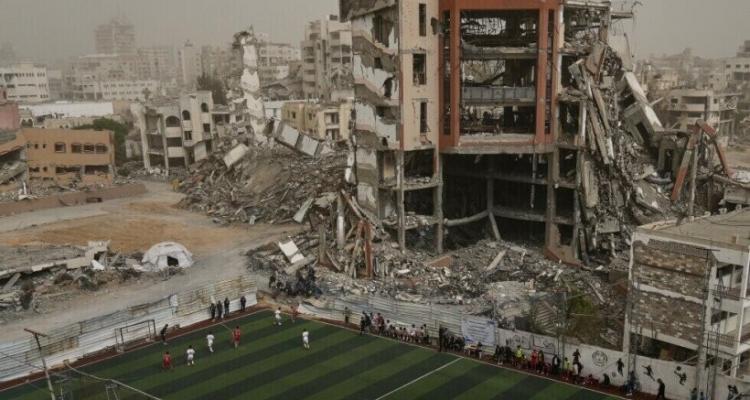
PARIS, Aug. 28 (YPA) – A photograph taken by Palestinian photographer Jihad al-Sharafi in the Gaza Strip has become the center of a major political and cultural controversy in France after it was abruptly removed from an exhibition at the Deauville sports photography festival and replaced with an image of cyclists.
The incident has raised questions about freedom of the press and photography, as well as political pressure linked to the war on Gaza.
The photo, taken by al-Sharafi, an Associated Press photographer, documents a soccer match between young Palestinian men on a rehabilitated field in Gaza City, surrounded on all sides by buildings destroyed during the war. The image contains no military symbols or political slogans.
The photograph was scheduled to remain on display as part of the festival until September 6, as one of the images documenting the relationship between sport and daily life. However, it suddenly disappeared from its place and was replaced by a photo of cyclists, without any clear initial explanation for the change.
According to French media reports, local official Sylvain Larcher noticed that the photograph had been removed. Deauville’s municipality subsequently acknowledged the decision, saying it wanted to avoid controversy and prevent the photograph from offending or upsetting any side. The municipality confirmed that it had received requests concerning the image but did not identify the parties who had made them.
French political figures and activists criticized the decision, accusing the festival organizers of yielding to pressure from pro-Israel supporters. According to L’Humanité, the removal came amid pressure from pro-Israel circles.
The photograph was also widely reshared by activists on social media, turning it from an image displayed at a sports festival into the focus of a broader debate over freedom of expression, censorship, and the way images of the war in Gaza are presented.
However, no official statement has confirmed that political pressure was the direct reason for the photograph’s removal. The timing of the controversy, along with apparent approval of the removal by some of the image’s critics, has nevertheless intensified questions surrounding the decision.
Ironically, the attempt to remove the photograph from the exhibition has helped it gain wider exposure, prompting a broader discussion about the role of photojournalism in documenting both everyday life and destruction in Gaza, as well as the limits of censorship when it comes to war and humanitarian issues.
@E.Y.M