

US military air build-up in Middle East raises tensions under fragile truce with Iran
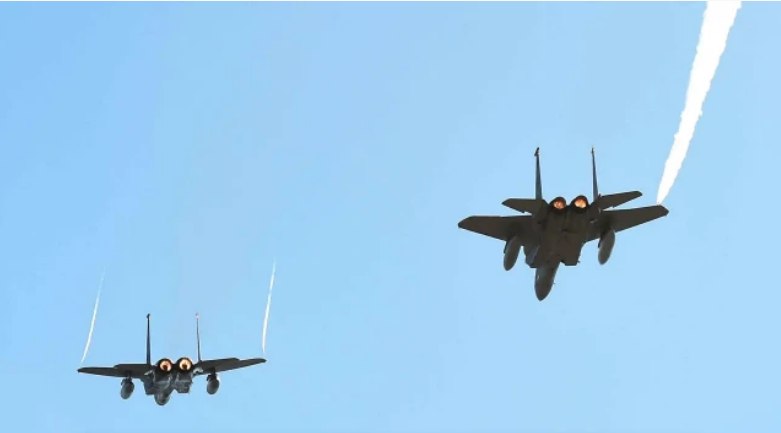
SANAA, May 30 (YPA) – In the context of escalating tensions between the United States and Iran, navigational data indicates a marked increase in military air traffic from European bases toward the Middle East, at a time when the situation remains volatile despite a fragile truce following the reported US-Israeli aggression against Iran on February 28.
Meanwhile, analysis of military aviation monitoring data points to a significant uptick in U.S. strategic airlift operations, raising questions about Washington’s intent to reinforce its military posture in the region and deepening concerns over the possibility of renewed escalation against Iran.
In this regard, the movement of heavy transport aircraft such as the C-17 Globemaster III and Lockheed C-5M Super Galaxy is seen as an indication of large-scale logistical deployments involving personnel and equipment, thereby reflecting an expansion of U.S. operational readiness in the region.
At the same time, these developments are accompanied by intensified intelligence activity, as RC-135 Rivet Joint aircraft were reported conducting reconnaissance operations over Bahrain. This, in turn, suggests that Washington is not only reinforcing its military presence, but is also prioritizing real-time monitoring of Iranian movements through expanded surveillance capabilities.
Accordingly, these parallel military and intelligence activities are widely interpreted as factors that could further heighten regional tensions and potentially trigger unexpected responses from Tehran, with broader political and security implications for an already fragile regional environment.
Moreover, technical tracking via flight-monitoring platforms shows that May 2 witnessed unusual activity involving transport squadrons departing from Europe, including Boeing KC-46 Pegasus tankers, underscoring sustained logistical support for extended operations.
As a result, some assessments suggest that continued escalation could increase the risk of a broader confrontation, particularly in light of persistent disputes over Iran’s nuclear program, expanding U.S. regional involvement, and evolving military calculations between the involved parties.
While diplomatic efforts continue, the situation remains precarious, and although international actors emphasize de-escalation through negotiation, such efforts appear increasingly constrained by current geopolitical dynamics.
In parallel, attention has also been drawn to the strategic importance of the Strait of Hormuz, which Iran may leverage as a pressure point in any future escalation, given its central role in global energy flows.
In this context, former U.S. President Donald Trump announced what he described as a ceasefire and an end to hostilities, stating in a letter to congressional leaders that no exchanges of fire had occurred since the declared truce.
However, political analysts have questioned this assessment, arguing that it may not accurately reflect conditions on the ground, particularly as military deployments and tensions continue to persist, suggesting that the underlying conflict remains unresolved.
Furthermore, concerns are reinforced by references to previous escalatory incidents, including the June 22, 2025 U.S. strike on Iran during a period of nuclear negotiations, which continues to shape perceptions of fragility in any current de-escalation framework.
AA