
Yemen is at heart of targeting, a map of blood, cantons to implement “Greater Israel” plan
SANAA, April 23 (YPA) – While the Zionist entity’s military machine is engaged in waging a war of extermination and destruction in Gaza and Lebanon, the outlines of a more far-reaching strategic project have begun to emerge, one that goes beyond “securing the borders” to redrawing the maps.
International reports and statements by officials in Tel Aviv today intersect with historical documents written decades ago, confirming that what is happening is not just a “security reaction,” but rather a systematic implementation of the “Greater Israel” project based on geographical, political and economic hegemony over the heart of the Arab world.
Even more dangerous, the “Greater Israel” project is no longer just a set of biblical slogans chanted by extremists, but has turned into a political doctrine adopted by ministers in the current government.
According to reports published in international newspapers in April 2026, the extreme Zionist right is strongly pushing for regional expansion. Officials in the occupying government have explicitly called for expansion towards “Damascus”, considering that Zionist sovereignty should extend to include the entire West Bank as a first step towards the “promised historical geography”.
In this context, the Hebrew media reveals the construction of a record number of settlement units in the West Bank, which is described as a “de facto annexation” that ends any chance of an independent Palestinian entity. This is supported by statements from American officials such as Ambassador Huckabee, who describes the lands of Israel stretching from the Nile to the Euphrates as a “Jewish right granted by God 3,000 years ago.”
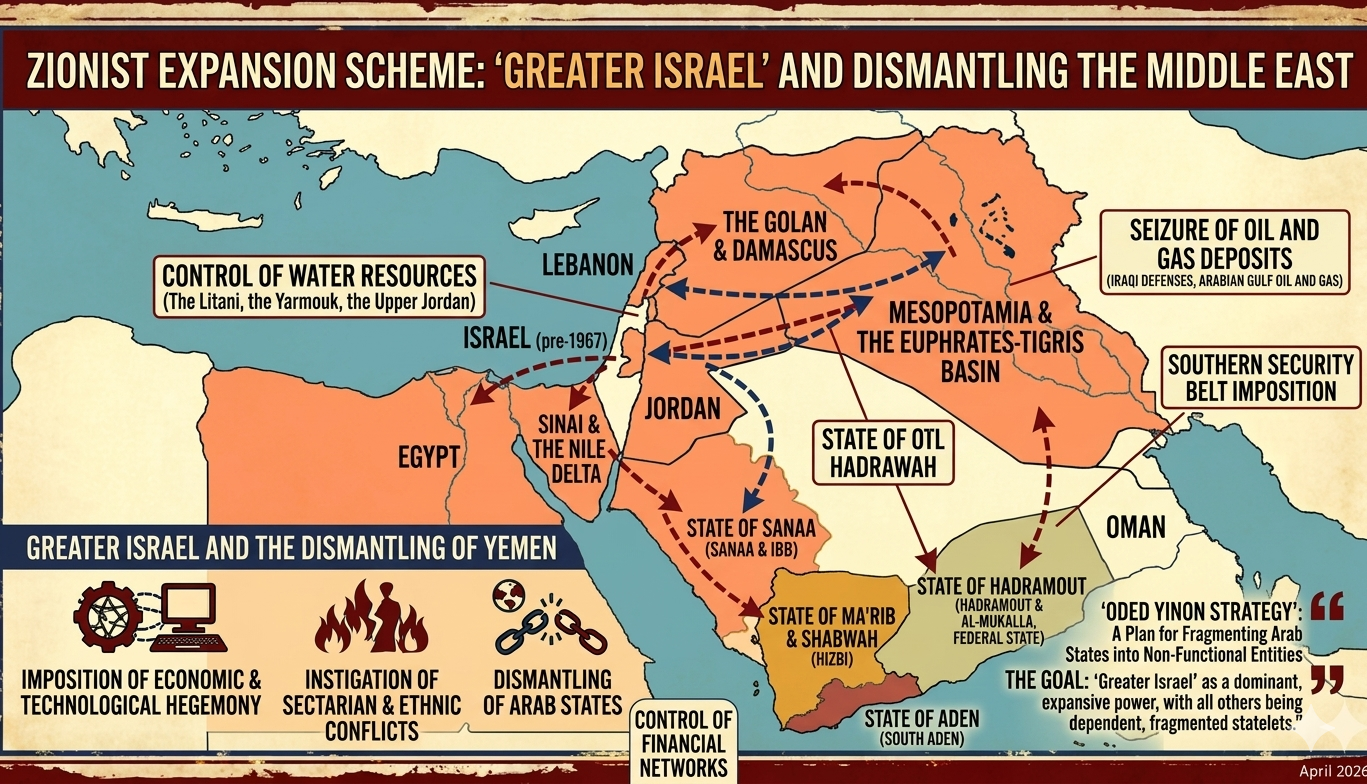
In a related and more dangerous context, the expansionist justifications are based primarily on the plan of the Zionist orientalist and Arabist “Oded Yinon”, published in February 1982 in the magazine “Kivunim”, which is considered a roadmap for dismantling the Arab states.
Herein lies the paradox: the plan does not rely solely on direct occupation, but is based on a “divide and rule” strategy by fueling sectarian and religious conflicts.
The document stated that Israel’s survival could only be achieved by dismantling the surrounding Arab states into warring ethnic and sectarian mini-states, thus ensuring that the Zionist entity would remain the sole dominant power.
Moving on to the activation of the plan on the ground in 2026, we find the scene unfolding with undeniable clarity. In Iraq, the Yinon Plan stipulated the necessity of dismantling it into three cantons (Shiite, Sunni, and Kurdish), and what we are witnessing today in terms of divisions and regional dependencies is an actual translation of this clause.
In Syria, Yinon considered it “the most important jewel in Israel’s crown.” The plan called for its fragmentation into mini-states (Alawite, Sunni, Druze) to serve as buffer zones, and field developments show that the entity is exploiting the state of disintegration to impose permanent security belts inside Syrian territory, penetrating towards the capital, Damascus.
As for Lebanon, it was identified as a prototype for division into five mini-states, which explains the systematic aggression against the infrastructure and the expansion towards the Litani River.
But the shocking surprise lies in the fact that reports from international agencies and human rights organizations confirm that Zionist expansion is not only for the sake of land, but also to control the “nerves of life” in the Middle East: water and energy.
In the water theft file, events revealed that the objective of the military operations in southern Lebanon revolves around controlling the Litani River, the second largest source of fresh water in Lebanon with an annual flow rate of up to 920 million cubic meters.
What’s worse, this ambition is not new; it dates back to the Paris Conference of 1919, where Chaim Weizmann called for the Litani River to be annexed as a “natural northern border” for the entity.
Today, loudly, the occupation’s finance minister, Bezalel Smotrich, is explicitly demanding that “Israel’s new border should be the Litani River,” and this is being implemented by destroying bridges, uprooting trees, and displacing residents to create a “buffer zone” that serves the water annexation project.
As for the energy blackmail file, the Israeli occupation is working to transform itself into a regional gas hub, in cooperation with American companies, which makes neighboring countries energy-dependent on the Zionist decision.
Hence, this project seeks to disrupt Arab ports and divert global trade routes towards occupied ports, within the framework of what is called the “resource subjugation map”.
The bitter truth revealed by the facts is that although Palestine and Lebanon receive great attention, strategic analysts indicate that the “Yinon” plan goes beyond the borders of the Arab world to reach second-tier neighbors.
In Yemen, the Zionist movements within reveal that the ongoing war is not merely an aggression against the resistance, but rather part of isolating the Red Sea and striking Arab shipping lanes for the benefit of Israeli ports, ultimately aiming to divide Yemen into mini-states (southern, northern, Hadramout) according to the Zionist vision of dismantling any Arab state capable of posing a threat.
On the other hand, regarding the Kurdish issue, reports issued in April 2026 indicate that the Zionist entity has begun to move the “Kurdish card” as a tool of pressure and fragmentation, as it works to revive the idea of a “Kurdish state” as an allied state, not in service of the Kurds, but as a spearhead to dismantle the northern neighboring countries. The next goal after Syria and Iraq is to ignite internal strife in Turkey by turning the political conflict into an ethnic conflict.
In confronting Iran, The Guardian and sources in Al-Jazeera confirmed that the continued aggression against Iran is not just a regional conflict, but rather the removal of the “last obstacle” to the Greater Israel project, as Netanyahu and the security elite believe that defeating Iran is the key to absolute control over the Middle East.
As a digression into the future dimension, analytical articles in April 2026 revealed that the Zionist leadership seeks to impose a new regional order (a system of hegemony) in which Israel becomes the “center and main driver,” and the rest of the Arab states are merely “dependent parties” (cantons).
What is most worrying is that this system includes: First, logistical dependence by turning Israeli ports into the sole gateways for trade and thwarting Arab land connectivity projects. Second, security dependency through the imposition of buffer and demilitarized zones in Syria and Lebanon, subjecting these countries to Israel’s early warning system. Third, normalization with the occupation as a capitulation imposed under military and economic pressure, not as a political choice.
Last but not least, the decisive conclusion: The facts revealed by intelligence reports and international agencies leave no room for doubt that the Zionist project is not merely a “border dispute” that can be resolved through concessions, but rather an existential conflict aimed at swallowing up the geography, dismantling the political identity of Arab states, and transforming the region into weak sectarian cantons that fight amongst themselves under absolute Zionist hegemony.
The extreme emergency situation that the Middle East is experiencing today, from the Atlantic Ocean to the Gulf, is a real translation of the blood of the martyrs on a map drawn by Oded Yinon 42 years ago.
Accordingly, in the face of this fateful danger, the peoples of the region have no choice but to restore their jihadist consciousness and overcome their internal differences in order to confront the partition plan that is being implemented on the ground now and not in books.
YPA