

Deeper Scenarios Than a Proxy War: Who Is Masterminding the Conflict in Eastern Yemen?
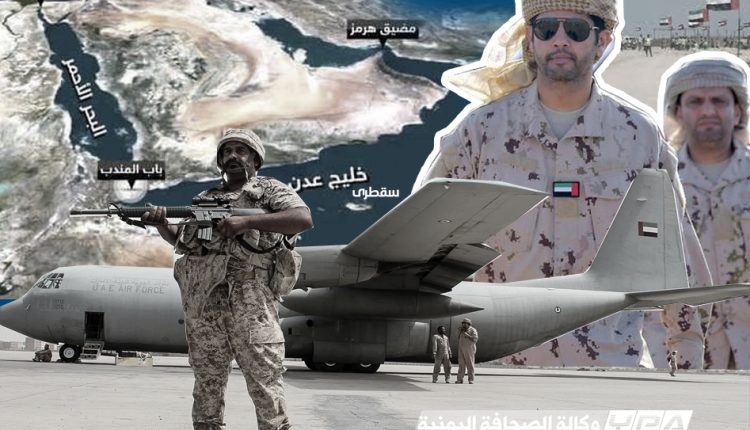
SANAA, Dec. 07 (YPA) -Over the past few months, Yemen’s eastern provinces, from Hadramout to Mahrah, have witnessed a rapid series of military and security shifts. These transformations include the sudden collapse of forces loyal to the Saudi-led coalition, a change in the balance of power in favor of UAE-backed militias, intermittent clashes, and a quick seizure of vital resources and ports.
However, reading this dramatic scene purely as an internal conflict between local proxies offers only a surface-level understanding of the crisis. The true context transcends Yemeni sovereignty, revealing a massive, international contest for control over the Arab Sea corridors, the Bab al-Mandeb Strait, and the vast mineral wealth of eastern Yemen. This conflict is part of regional arrangements designed to serve major global powers, led by the United States and the Israeli occupation entity.
International powers do not treat the coalition-held regions of Yemen as a local issue, but rather as a strategic point that influences key Arabian Sea ports and controls international navigation lines near Bab al-Mandeb Strait . This is compounded by ongoing efforts to seize massive oil and gas reserves across Hadramout, Mahra, and Shabwa.
As a result, eastern Yemen is a crossroads where the interests of the US, the Israeli Entity, Britain, France, China, the UAE, and Saudi Arabia all converge. Since these powers view a unified and strong Yemen as a direct threat to their maritime influence, the ongoing effort is to deliberately produce a sustained environment of fragmentation and complicated political allegiances.
Regional Proxies for a Larger International Agenda
Following the normalization agreement between the UAE and the Israeli Entity, Abu Dhabi has evolved into a direct maritime and security partner for Israel. This partnership is evident in the UAE’s effective control over vital ports, its escalating influence in the Socotra Archipelago, and robust naval, intelligence, and logistical cooperation.
According to political sources, the Emirati presence on Yemen’s coasts and islands is not a self-contained Emirati project. Rather, it is part of arrangements designed to ensure Israel freedom of movement in strategic sea lanes and shipping corridors.
Meanwhile, Riyadh’s actions are historically tied to the American political, military, and economic framework. Therefore, its intervention in eastern and southern Yemen is seen as aligning with Washington’s goals first, rather than an independent Saudi agenda.
The ensuing conflict between Riyadh and Abu Dhabi’s local proxies in Hadramout and Mahra was outwardly cast as a local dispute. Security analysts, however, argue that the UAE is strategically re-establishing control over ports and maritime routes, while Saudi Arabia seeks to curb the Emiratis reach toward Mahra and prevent their monopolization of the eastern resources.
The rapid collapse of the Islah Party-affiliated factions in both governorates has definitively reshaped the map in favor of the UAE-backed factions .
Sanaa: Eastern and Southern Conflicts Serve “External Agendas“
Brigadier General Mohammed Al-Sharif, an Advisor to the Ministry of Defense, told the Yemen Press Agency (YPA) that the recent tensions in the eastern and southern governorates are not mere factional clashes but part of a larger scheme aimed at dismembering Yemen through internal conflicts that serve external agendas.
Brigadier General Al-Sharif added that the recent developments fall within the context of “previous hostile statements launched by officials in the Israeli occupation entity and the United States over the past two years, as part of attempts to pressure Sanaa to cease its support for the Palestinian people in Gaza.
Al-Sharif warned against any steps that could undermine Yemen’s security and stability.
He sent clear cautionary messages to Saudi Arabia and the UAE not to get involved in fueling internal conflicts in response to American, British, and Israeli pressure, stressing that Yemen has become a regional military power that cannot be underestimated.
He further affirmed that the failure of the United States in the Red Sea, and the failure of the Israeli Entity to stop Sanaa’s support for Gaza, have driven “the enemies to mobilize their regional tools and local factions to strike Yemen and seize its resources.”
Beyond Takeover of Hadramout and Mahra
The takeover of Hadramout and Mahra by UAE-backed factions—and the expulsion of groups associated with the Islah Party—marks a new phase in a series of international arrangements aimed at reshaping influence in the coalition-held areas in southern and eastern Yemen.
According to military experts, these shifts are merely a prelude to a coming stage aimed at solidifying a long-term presence for the UAE and the Israeli entity along Yemen’s coasts and islands.
This includes attempts to ensure control over maritime navigation lines for the benefit of Western powers, and to keep Yemen in a state of sustained division.
It is clear that what is happening in southern and eastern Yemen today is not just a conflict between rival factions, but a new chapter in an international conflict over sea lanes, wealth, and Yemen’s sovereign decision-making.
While international powers manage the scene through regional and local proxies, southern and eastern Yemen—with its vast resources and sensitive areas— remains the nexus of converging interests that go far beyond Yemen’s national boundaries.
The remaining question is: Will the Yemeni people stand idly by while their homeland is fragmented, or will they voice an opinion that can overturn the balance of power?!
@E.Y.M