

Sheikh Naim Qassem reaffirms commitment to Nasrallah’s approach, vows resistance to continue
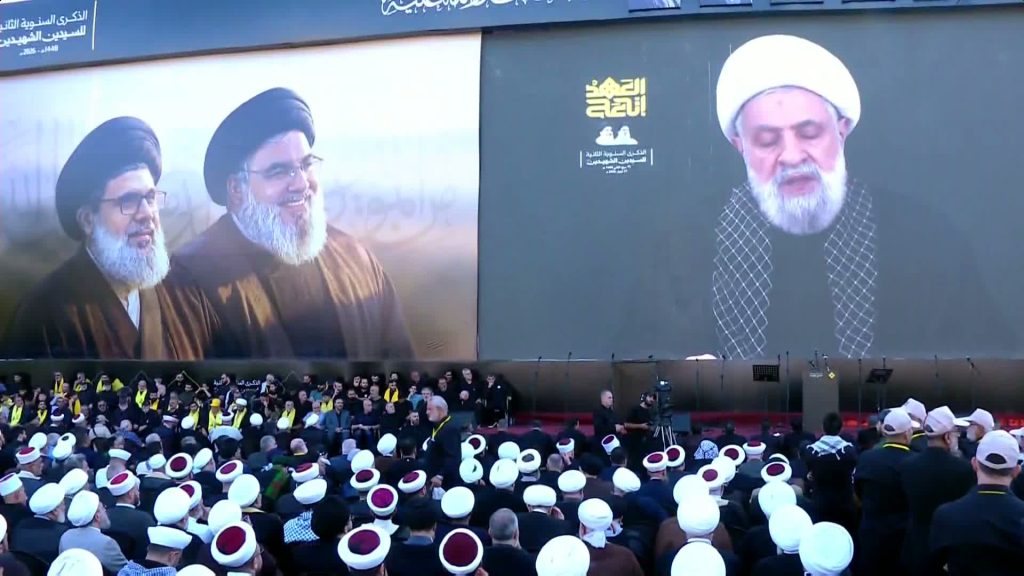
BEIRUT, Sept. 28 (YPA) – Lebanon’s Hezbollah Secretary-General Sheikh Naim Qassem reaffirmed the group’s commitment to the approach established by Sayyed Hassan Nasrallah, saying the resistance would continue along his path, in a speech marking the second anniversary of the martyrdom of Sayyed Nasrallah and Sayyed Hashem Safieddine.
Addressing Nasrallah, Qassem said, “You left with your body, but your teachings remain,” adding that the light of his legacy continues to provide the group with determination. He said Nasrallah built a party, a resistance movement and a strong, steadfast popular base, stressing that Hezbollah would continue on the same path.
Qassem stressed that Nasrallah carried the banner of Palestine and made it part of their lives, affirming that Palestine would remain the compass and the liberation of their land a priority.
Speaking about Safieddine, Qassem said his career was marked by jihad and service within Hezbollah and that he had been a close aide and supporter of Nasrallah. He said Safieddine would remain a landmark in the resistance’s path.
He saluted the families of the martyrs and those he described as living martyrs among those wounded in the pager explosions, praising their transformation of their wounds into action and resistance. He also paid tribute to 3,400 men and women killed and 14,600 wounded among resistance members and civilians in the “Uli al-Ba’s” battle.
Qassem said the slogan “We remain committed to the covenant” means continuing the struggle, adding that when a leadership figure is martyred, a new leadership emerges to continue the previous leadership’s approach. He stressed preserving the group’s principles, foremost among them a courageous and dignified resistance confronting aggression.
He clarified the resistance would continue confronting the occupation until it leaves Lebanese territory and full liberation is achieved, adding that remaining committed to the covenant also means preserving the trust of the martyrs, particularly Nasrallah, supporting and liberating Palestine, and fully liberating Lebanese territory.
On the confrontation with Israeli occupation, Qassem said the resistance had halted the aggression’s project and prevented it from achieving its objectives. He said it had confronted Israeli forces whose numbers he put at 90,000 soldiers and officers, preventing them from consolidating their occupation and establishing settlements in Lebanon.
He added that resistance fighters had halted the advance of Israeli brigades and tens of thousands of troops despite bombardment and destruction, citing their resistance in Bint Jbeil, Khiam, Ayta al-Shaab, Naqoura, Al-Bayada, Ali al-Taher and other areas in southern Lebanon.
Qassem said the resistance was confronting Israeli occupation along two tracks: direct confrontation in place and time to the extent possible, and preventing the enemy from establishing a permanent presence. He said details of the management and nature of the battle could not be disclosed.
Qassem argued that the problem lies with the aggression, not the resistance, saying that surrender to the occupation would mean the end of Lebanon as a country of coexistence in favor of Israeli settlements.
He stressed that Hezbollah would not accept surrender, saying Lebanon belongs to all its people and they must reach agreement without relinquishing a single inch of the country’s 10,452 square kilometers. He described southern Lebanon as the foundation, pillar and future of the country.
On the political front, Qassem said the memorandum of understanding had reduced the level of escalation to its current level, questioning the continued demands for the disarmament of the resistance. He rejected calls for the Lebanese Army to become an instrument for disarming the resistance, stressing that the army is a national institution and that Lebanese people should reach an understanding among themselves.
Qassem affirmed that the framework agreement had, in a single session, provided everything Lebanon could discuss or offer in the interest of the enemy, accusing the authorities of relinquishing all sources of strength and presenting the enemy’s demands all at once.
He emphasized the authorities had held seven rounds of direct negotiations and questioned their outcome, saying they had produced results below zero. He acknowledged the president’s right to negotiate but said he had no right to violate the Constitution, the Taif Agreement, his oath of office or the ministerial statement, or to relinquish Lebanon’s rights.
Qassem called for freezing direct negotiations and moving to indirect negotiations, saying Hezbollah was ready for dialogue while questioning how dialogue could take place with those who had declared the resistance and its people to be outside the law.
He said any Israeli withdrawal from territory or plan to withdraw would be the result of the resistance and the memorandum of understanding, rather than negotiations.
On the consequences of the war, Qassem noted that the state is responsible for shelter, compensation, reconstruction and restoration. He announced that Hezbollah would also undertake shelter, restoration and reconstruction efforts using its own resources and donations, adding that the group would soon announce its contribution to a housing project and provide details.
On the economy, Qassem questioned the government’s role amid deteriorating economic conditions, rising living costs, the weakening Lebanese currency and a lack of improvement in public services. He also raised questions about electricity, the Foreign Ministry and depositors’ funds.
Regarding the issue of exclusive state control over weapons, Qassem said Hezbollah was ready for dialogue and discussion, adding: “First liberate the south so the people can return, and then we can reach an understanding among ourselves.”
At the international level, Qassem said the United States was seeking to control the world, arguing that the global justice system and international law no longer existed. He pointed to the scene at the United Nations as evidence that the enemy had become globally isolated.
At the conclusion of his speech, Qassem saluted Iran, saying it had provided Sayyed Imam Leader Sayyed Ali Khamenei. He reaffirmed that Palestine is the symbol and face of the future, describing the Palestinian people as great, sacrificing and generous and the rightful owners of their land.
@@