

Sanaa reveals integrated deterrence strategy to pressure Riyadh to lift blockade
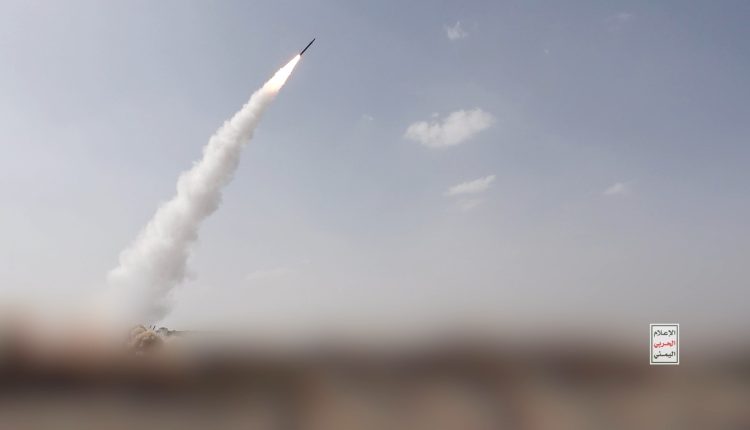
SANAA, Aug. 19 (YPA) – A statement by Yemen’s Sanaa-based armed forces spokesperson Brig. Gen. Yahya Sarie on Wednesday revealed that Sanaa has adopted an integrated military strategy to confront Riyadh based on comprehensive deterrence, aimed at narrowing Saudi Arabia’s options and raising the cost of maintaining the blockade and escalation, ultimately seeking to compel Riyadh to lift the blockade imposed on the Yemeni people—a condition Sanaa has set for ending the escalation with Saudi Arabia.
The operational tracks announced by Brig. Gen. Sarie are blockade for blockade, protecting Yemeni sovereignty from incursions, and targeting Saudi military buildups wherever they are located. Although these three equations operate across different arenas, they share a single objective: shifting the cost of continued confrontation onto the party insisting on maintaining the blockade and escalation.
Blockade for blockade
The blockade for blockade equation stands at the forefront of the deterrence system, serving as the foundation of the new confrontation with Riyadh. As Saudi Arabia continues to impose a blockade on Yemen and refuses demands to lift it, Sanaa has chosen to shift the confrontation into the maritime domain linked to Saudi interests, making oil and shipping movements part of the reciprocal pressure equation.
According to statistics announced by Brig. Gen. Sarie, Sanaa forces have targeted eight Saudi oil tankers since the decision to ban maritime navigation to Saudi Arabia was announced on July 20, including five in the Red Sea and three in the Gulf of Aden and Arabian Sea. They also prevented 48 Saudi oil vessels from passing through and forced them to turn back.
The military significance of this equation lies in transforming the blockade from a one-sided pressure tool into a reciprocal pressure mechanism: the blockade on Yemen is met with restrictions on Riyadh and pressure on Saudi interests.
Protecting Yemeni sovereignty
Alongside maritime pressure, Sanaa has established the protection of Yemeni sovereignty from incursions as the second pillar of its deterrence system.
According to the spokesman, Sanaa forces carried out nine military operations under this equation targeting sites in Yanbu, Najran, Jizan, Abha and oil supplies in the Eastern Province, in response to Saudi attacks on Sanaa airport and Hodeida Port.
Militarily, this equation means that Sanaa does not want its response to remain confined to Yemeni territory. Instead, it seeks to make any attack on Yemen potentially subject to retaliation deep inside Saudi territory. This raises the cost of military decisions for Riyadh, as any operation against Yemen could entail retaliatory attacks against Saudi sites and interests, forcing the Saudi leadership to calculate the consequences of escalation with Sanaa.
Targeting Saudi military buildups
The third equation involves targeting Saudi military buildups wherever they are located, in an effort to strike offensive capabilities before they develop into military operations.
According to Saree’s figures, Sanaa forces carried out 14 operations targeting Saudi military concentrations in Al-Ruwaik, Al-Abr, Al-Wadiah, Marib and Mocha, in addition to ships and boats transporting equipment and military personnel.
This equation reflects an attempt to treat military mobilization as part of the confrontation from the moment forces are assembled and equipment and supplies are transported, rather than waiting until they reach the front lines.
According to Saree, the operations resulted in the deaths and injuries of hundreds of members of the Saudi military buildups, including Saudi commanders and officers, as well as the burning and destruction of warehouses and equipment and the sinking and burning of vessels and boats linked to the transportation of weapons and military forces.
Narrowing Riyadh’s options
The strategic strength of the three equations lies in their integration into a single deterrence system targeting some of the main sources of leverage available to Riyadh.
The blockade for blockade equation transfers the cost of the blockade to Saudi maritime and economic interests; the sovereignty-protection equation makes any attack on Yemen potentially subject to retaliation deep inside Saudi territory; while the targeting of military buildups seeks to neutralize the ground offensive option before it develops into a large-scale military operation.
More specifically, targeting Saudi military buildups wherever they are located gradually deprives Riyadh of the option of launching a ground offensive against areas controlled by Sanaa by exhausting troops, equipment and supply lines before they reach the confrontation lines. This makes the formation of an offensive force capable of achieving a battlefield breakthrough more difficult and costly.
Thus, if Riyadh chooses escalation, it would not face a single front that could be contained, but rather a response system extending from the sea to the Saudi interior and onward to military mobilization and ground-offensive fronts. Each time Riyadh attempts to use one pressure tool, it faces a corresponding countermeasure, narrowing its room for maneuver and making escalation more costly and complex.
In this sense, the core of the deterrence system being developed by Sanaa is to strip Riyadh of its principal escalation tools and force it to reassess its calculations. As the cost of military action rises and the prospects of achieving its objectives decline, Riyadh’s options become narrower, while lifting the blockade becomes a less costly and more realistic course.
Forcing Riyadh to lift the blockade
Sanaa has made clear that the objective of these equations goes beyond the military dimension to achieving the goal of lifting the blockade.
Brig. Gen. Yahya Sarie stressed that the Saudi regime has no option but to lift the blockade and implement the agreements reached to end the aggression, pay salaries, withdraw occupying forces and leave Yemen’s resources to the Yemeni people.
Accordingly, the deterrence system being built by Sanaa is not aimed at war for the sake of war, but at using the balance of power to impose costs that make lifting the blockade a more realistic option for Riyadh.
The objective of deterrence is therefore not necessarily to trigger an open confrontation, but to prevent the other side from believing that it can continue imposing the blockade and escalating tensions without paying a price.
AA