

Saudi Arabia’s new alliance with Turkey, Pakistan: Strategic partnership or temporary arrangement?
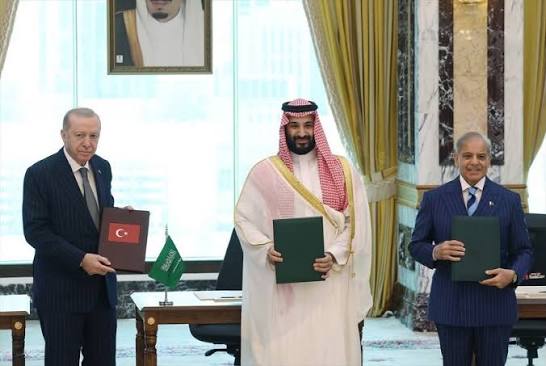
SANAA, Aug. 09 (YPA) – In an announcement raising a number of questions, Riyadh unveiled a new alliance bringing together Saudi Arabia, Pakistan and Türkiye.
What is the objective of this alliance, and how can its inherent contradictions be overcome—whether in terms of its formal structure or the divergent interests of its members, which appear to lack a common strategic objective?
Conflicting Interests
Türkiye maintains strong relations with Israel, as does Saudi Arabia, while Pakistan maintains close ties with Iran. This makes the objectives of what has been described as the “Mecca Agreement” unclear.
The initiative appears to be primarily driven by Saudi Arabia. Türkiye, as a member of NATO, does not require security protection from Saudi Arabia. Moreover, Turkey’s domestic political tensions could make Ankara reluctant to join alliances that might fuel internal discontent or strengthen opposition parties, which have increasingly challenged the ruling Justice and Development Party led by President Recep Tayyip Erdoğan.
Pakistan, meanwhile, possesses a nuclear deterrent and substantial military capabilities, making it a formidable rival to its traditional adversary, India. It therefore has little need for a military alliance with Saudi Arabia.
Against this backdrop, Saudi financial incentives appear to be a major factor behind Ankara and Islamabad’s interest in the trilateral arrangement.
Saudi Arabia’s Repetition of a Failed Approach
Türkiye and Pakistan also appear to possess sufficient regional experience to avoid moves that could expose them to hostility from Yemen. Both countries previously refrained from joining the coalition formed by Saudi Arabia against Yemen, and neither appears eager to enter alliances that do not directly serve their national interests.
Much has changed over the past 12 years, however, and Yemen has emerged as a significant factor in the region’s war-and-peace equations. There may therefore be few incentives for Türkiye or Pakistan to alter their positions in ways that could provoke Sanaa.
With Saudi Arabia’s reliance on the United States failing to produce the desired security outcomes, Riyadh has little reason not to seek alternative security arrangements, hoping they might yield new results and strengthen its position in Yemen.
Yet the contradictions surrounding the trilateral alliance appear to be deeper than minor gaps that can simply be bridged by political preferences.
The new alliance has been described as a “defensive alliance,” which directly conflicts with Saudi Arabia’s apparent objective of maintaining the blockade and military pressure on Yemen. Such policies are offensive in nature and therefore difficult to reconcile with the defensive principle on which the alliance with Türkiye and Pakistan is officially based.
A Strategic Arrangement or a Long-Term Alliance?
Ultimately, the trilateral alliance between Saudi Arabia, Türkiye and Pakistan faces a series of questions from the moment of its announcement regarding its nature, objectives and the ability of its members to transform a political understanding into a sustainable and operational framework.
The divergent interests and differing regional calculations of the three countries make it difficult to identify a unified objective extending beyond their immediate national interests.
Riyadh appears to be the party most in need of such an arrangement, as it seeks to strengthen its security and regional position and establish new strategic guarantees amid rapidly changing regional dynamics. Türkiye and Pakistan, by contrast, have their own calculations and may be unwilling to bear the costs of involvement in any confrontation that does not directly align with their national interests.
Repositioning or Long-Term Partnership?
The alliance’s real test, therefore, will not come through political statements or the titles attached to the agreement, but through its ability to withstand its first genuine crisis and demonstrate how cohesive it really is.
If it remains a “defensive alliance” as officially described, any attempt to turn it into an instrument for advancing offensive agendas or imposing military options in Yemen would create a fundamental contradiction that could prove difficult to contain.
AA