

Over 13 Production Sectors Destroyed, with $57 Billion Lost in Yemen’s Oil, Mineral Sector
Yemen’s Lifelines Under Bombardment, Blockade
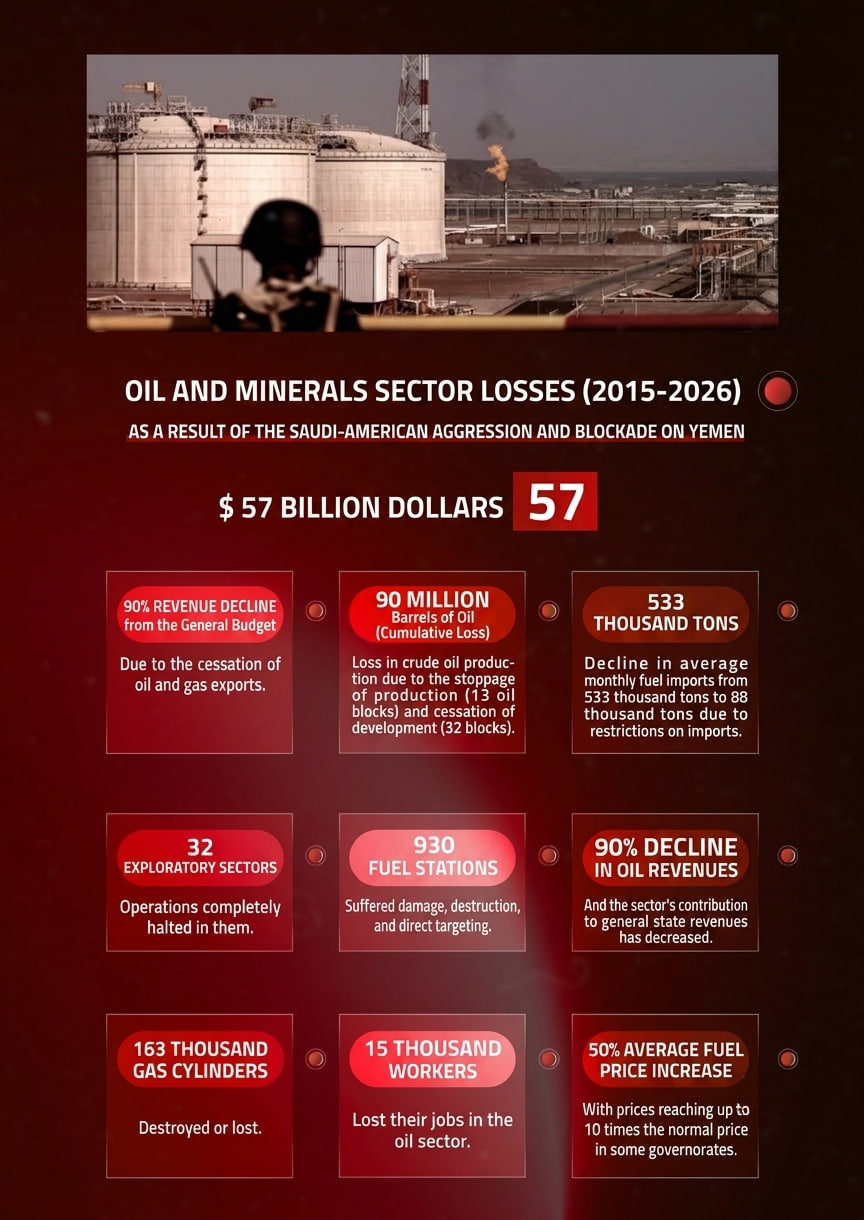
SANAA, Aug. 03 (YPA) – Yemen’s Sana’a-based Ministry of Economy, Industry, and Investment announced on Monday that the country’s oil and mineral sector has suffered devastating losses over the past 12 years (2015–2026) as a result of the aggression waged by the U.S.-backed Saudi-led coalition against Yemen.
In an official statement, the Ministry affirmed that the Saudi-led aggression coalition, coupled with a comprehensive and systematic blockade of Yemen’s maritime, land, and air ports, formed part of a deliberate strategy aimed at crippling the national economy, exacerbating humanitarian suffering, and subjecting the country to the will of foreign powers.
According to comprehensive assessments documented in a spatial analysis published by the Ministry, total losses in this vital sector reached an estimated $57 billion.This represents a direct and systematic targeting of infrastructure and sovereign resources, which constitute the backbone of the national economy and the primary lifeline for citizens’ livelihoods, as well as the state’s fulfillment of its service and operational obligations.
It should not be overlooked that what Yemen’s oil and mineral sector has endured for over a decade due to the Saudi-American aggression represents one of the largest economic disasters witnessed by the region in modern history.
Additionally, direct and indirect losses surpassed all initial estimates established by regional and international institutions at the onset of the crisis. This is attributed to the strategic weight of this sector within the structure of the Yemeni economy, as it served as the state’s main window into global energy markets and nearly the sole source of public revenue sustaining the budget and driving the wheel of development across the nation.
Furthermore, direct military aggression targeting production and export areas—coupled with the unjust siege imposed by Saudi-led coalition forces on ports and border crossings—created a state of complete paralysis for this vital sector. It transformed it from a primary contributor to the national economy into an additional burden on the general budget amid the cessation of production, the destruction of infrastructure, and the erosion of machinery and equipment.
Consequently, the country remains under the weight of a structural crisis that has battered its economic foundations and stripped its capacity to withstand accumulating challenges.
Destruction of Productive Lifelines and Cessation of Exploration Due to Direct Bombardment
Proceeding from this bitter reality brought about by continuous airstrikes and systematic artillery shelling, the catastrophic details of direct losses sustained by the extractive and production sectors become starkly evident.
Official data indicate that Yemen lost the capacity to produce approximately 90 million barrels of crude oil annually—a figure equivalent to the total proven oil reserves produced nationwide prior to 2015, which then formed the core of the national economy.
In this context, this massive loss comes as a result of the forced halt and complete removal from service of thirteen production sectors that had managed extraction and export operations with acceptable efficiency despite prior technical and logistical challenges.
This occurred after these sectors were subjected to intensive bombardment by Saudi-American coalition aircraft, not to mention the total disruption of thirty-two exploration sectors that represented the future pipeline for developing the country’s oil and gas reserves. This demonstrates that damage was not confined to the present, but extended to the future of the sector and its capacity to recover and relaunch.
From the same perspective, field assessments confirm that destruction was not limited to disabling wells and production sectors, but also extended to internal distribution and storage networks that served as the intermediary link between domestic production and consumption. Assessments were documented direct targeting and widespread destruction of 930 fuel stations across various Yemeni provinces due to airstrikes and indiscriminate shelling, alongside the destruction and loss of over 163,000 domestic gas cylinders.
This multiplied pressures on the local oil derivatives and gas market, creating severe bottlenecks in supplies destined for civilian and industrial consumption. It contributed significantly to rising living costs and the deterioration of basic services provided to citizens across the country, while increasing reliance on the black market and unlicensed traders to meet the population’s essential material needs—a situation warning of an imminent collapse of regulated markets and widespread chaos in distribution and pricing mechanisms.
Collapse of Public Revenue and Budget Contraction Due to Blockade and Export Bans
Shifting to the macroeconomic level, it becomes clear that the forced halt of crude oil and liquefied natural gas (LNG) exports—resulting from the naval blockade imposed by Saudi forces on Yemeni ports and the prevention of oil tankers from departing—caused a sharp drop and complete paralysis of public revenue streams.
Official data state that oil revenues experienced a 90% decline, leading directly to a corresponding drop in state general budget revenues. This dried up the primary source the state treasury relied upon to cover operational expenses, pay public sector salaries, and fund basic services such as education, healthcare, and infrastructure—a clear maneuver by Coalition countries aimed at impoverishing the Yemeni state and subjecting it economically and politically.
Conversely, the sectoral contribution of oil and minerals to the Gross Domestic Product (GDP) dropped to its lowest historical levels, leading to structural imbalances in the balance of payments and a sharp decline in foreign currency supply. This was accompanied by immediate repercussions on the local currency’s purchasing power and inflation rates surging to unprecedented levels, alongside eroding confidence in national banking and financial institutions and rising poverty and unemployment among the population—outcomes that were anticipated within the declared goals of the aggressive war waged by US-backed Saudi Arabia against Yemen.
It is vital to note that these negative shifts were not accidental, but the inevitable consequence of the blockade and closure policy aimed at paralyzing the national economy and subjecting it to external wills within the framework of the comprehensive economic war accompanying the military aggression.
Choking Imports and Market Suffocation Under Naval Blockade
This manifested clearly in the severe restrictions and systematic, strict measures imposed by Saudi Coalition forces on the entry of oil derivatives and gas tankers through Yemeni ports. Average monthly fuel imports plummeted from 533,000 tons to just 88,000 tons—a harsh reduction of approximately 83%. This left the country in a chronic deficit regarding its fuel requirements, even amid reduced consumption levels caused by the shutdown of most economic, industrial, and service activities, vividly reflecting the scale of the suffocating Saudi blockade on the Yemeni people.
Accordingly, the acute supply shortage directly impacted local derivative prices, where average price increases recorded at least 50% during periods of relative stability. Meanwhile, prices exceeded ten times their baseline value during severe crisis periods and intensified naval bans on fuel shipments in various governorates. This added to the living burden borne by Yemeni families, who spent an increasing proportion of their limited income securing basic energy and fuel needs, worsening poverty, broadening the scope of deprivation among the most vulnerable groups, and triggering unprecedented internal displacement and migration waves due to deteriorating living conditions.
Bleeding in the Labor Market and Layoffs of National Cadres Driven by Economic Warfare
It is unavoidable to point out that the economic damage stemming from the Saudi-American aggression undoubtedly reached the social and humanitarian spheres. The total disruption of foreign and local oil companies and the halt of exploration and extraction operations—due to continuous bombardment and the imposed blockade—severely struck the direct labor market in this sector.
Official statistics indicate that over 15,000 workers, technicians, and engineers lost their jobs and dignified livelihoods in the oil sector and related services, joining the expanding ranks of unemployment that Yemeni society has suffered throughout the years of aggression. This represents a loss of trained national expertise and cadres who formed the vital human capital of this strategic sector, alongside the social impact of an increasing number of families losing their sole income source amidst the absence of effective social safety nets and the degradation of institutional state capacity to offer suitable alternatives. This stands as a direct result of the aggressive economic policies pursued by Saudi Arabia with U.S. support to weaken the Yemeni social fabric.
Similarly, repercussions extended to the broader societal framework. Worsening economic conditions created by aggression and blockade led to increased internal and external migration rates, the fraying of family ties, and rising instances of violence and organized crime, alongside deteriorating human development indicators across the Republic’s provinces. This makes restoring the health of the oil sector a humanitarian necessity before an economic one, as maintaining the cohesion and stability of Yemeni society is intrinsically linked to the state’s capacity to provide job opportunities and dignified income—an objective unachievable without reviving the oil sector, restoring it to its natural state, and lifting the unjust blockade imposed by coalition forces.
Cross-Sectoral Operational Impact on Vital and Service Sectors Due to Fuel Shortages
Furthermore, given that oil and fuel derivatives serve as the primary engine for all service and development sectors, the systematic fuel shortage—alongside restrictions on energy and water systems under the comprehensive blockade—generated a chain of severe, lingering operational impacts across economic and social life. This reflected clearly in the electricity and power sector, where the detention of fuel shipments and supply halts caused the near-total shutdown of most government-owned power generation stations. This plunged major cities and expansive regions into complete darkness, compounded the humanitarian suffering endured by the Yemeni people due to aggression, directly hindered the operation of service and industrial facilities, and made reliance on commercial private generators the sole electricity source in many areas, carrying high costs and evident environmental pollution.
Additionally, the acute shortage of oil derivatives caused the disruption and cessation of operational funding for more than 1,265 vital field projects in direct transportation, sanitation, urban improvement, and environmental management. This led to waste accumulation in urban centers and environmental and health risks for residents. It also severely impacted the capacity of service institutions to execute daily tasks, increased citizen hardship in travel and accessing basic services, and contributed to the decay of the urban landscape across many cities and areas that had witnessed noticeable progress in sanitation and improvement standards prior to the outbreak of the brutal aggression.
Halt of Distribution Networks and Transportation Collapse Under Blockade
In a related context, retail and distribution networks were widely impacted by supply shortages and facility destruction caused by continuous airstrikes, resulting in supply halts to over 2,000 fuel stations that previously served citizens and public and private transport across various regions, creating a severe supply crisis in numerous governorates. It deepened citizen reliance on the unregulated parallel market and raised internal transport and freight costs, steadily driving up the prices of food and consumer goods while negatively impacting internal trade and commerce between governorates—a picture illustrating the scale of destruction inflicted by the Saudi-American war on the infrastructure of the Yemeni economy.
Telecommunications and IT Disruptions Driven by Energy Outages
Reinforcing these data, the telecommunications and information technology sector similarly suffered from the impacts of aggression and blockade. The fuel crisis and power outages led to the disruption and shutdown of 79% of telecommunications and IT projects and stations, given the reliance of towers and technical support units on diesel generators for continuous power. This threatened to isolate vast areas, degraded connection and internet service quality, impacted commercial operations, banking services, and remote education, heightened the isolation of local communities, and prevented them from leveraging modern technology opportunities. It also hampered the ability of government and private institutions to communicate with partners and beneficiaries, complicating service and administrative conditions nationwide and deepening the humanitarian crisis affecting millions.
Threat to Food Security and Agricultural Sector Collapse
Moreover, the greatest harm befell farmers who rely entirely on oil derivatives to pump irrigation water and operate agricultural machinery.
Over 1.2 million farmers have been directly affected, leading to a contraction of cultivated areas, crop spoilage, and soaring agricultural production costs, which have threatened local food security and placed additional pressure on Yemeni families striving to secure daily food, particularly amidst declining domestic production and rising prices of imported food commodities driven by inflated shipping, transport, and insurance costs. This was compounded by the systematic detention of food vessels at Coalition ports, rendering the country increasingly dependent on international humanitarian and food assistance while stripping its capacity to achieve self-sufficiency in a vital domain of national security—a flagrant violation of international humanitarian law.
Water and Sanitation Crisis Amid Blockade
Concurrently, the water and sanitation sector has been faced a severe operational crisis due to the inability of pumps and treatment plants to obtain necessary fuel under the imposed blockade on oil derivatives, leading to the disruption of fuel supplies to 22,975 water and sanitation projects across urban and rural areas, depriving millions of citizens of clean drinking water, accelerating the spread of waterborne diseases and epidemics, and casting a heavy shadow over public health—particularly among children, the elderly, and the most vulnerable groups. It further multiplied burdens on a health sector already suffering from acute resource and medical staff shortages due to years of ongoing aggression.
Health System Paralysis and Threat to Patient Lives Due to Aggression
Reflecting the scale of the tragedy that the Yemeni people has endured by the Saudi-American aggression and unjust blockade, fuel shortages in the healthcare sector represented a direct threat to patient lives in care facilities. It caused disruptions in supplying and securing operational energy for 4,500 hospitals, centers, and health facilities across governorates, threatening the shutdown of operating rooms, intensive care units, dialysis departments, and neonatal incubators. This put thousands of patients reliant on these vital services at risk, increased mortality and chronic illness rates, contributed to degrading health indicators nationwide, and doubled burdens on medical and nursing staff working under extremely difficult conditions and severe resource shortages.
Consequently, the national health system stands on the brink of total collapse across most governorates—a humanitarian crime added to the record of violations by the Saudi-American Coalition.
Demands for Recovery Support and Protection of Sovereign Assets
The Ministry of Economy, Industry, and Investment of the Sana’a Government affirmed that the targeting of the oil and mineral sector by the Saudi-American Coalition was not merely a transient financial loss or localized economic damage. Rather, it was a systematic strategy designed to strip the national economy of its resilience factors and transition the country from financial independence and self-reliance to total dependence on foreign aid and international relief. This leaves national sovereignty hostage to external wills and decisions that disregard the supreme interests of the Yemeni people within the framework of the comprehensive economic war accompanying military aggression.
The appalling reality reflected in these quantitative and qualitative data warrants serious reflection. The heavy toll exceeding $57 billion does not merely measure the lost natural wealth and production facilities, but also embodies lost development and progress opportunities that would have transformed the lives of millions of Yemenis had the wheels of production continued turning unimpeded by the machinery of aggression and blockade.
From this standpoint, the Ministry emphasized that the scale of direct and indirect damage demands concerted national and international efforts to support economic recovery plans, rebuild damaged infrastructure, lift all strict restrictions imposed by the Saudi Coalition on fuel and essential cargo vessels, and hold aggression states accountable for the destruction inflicted upon the national economy. This is imperative to ensure this vital sector recovers its role in driving sustainable development and livelihood stability for the Yemeni people, returning to its pre-aggression leading status within the national and regional economy.
Cumulative Losses and Recovery Prospects Amid Blockade
Consequently, the figures and indicators established by official assessments do not capture the full extent of the catastrophe that befell the Yemeni economy due to the Saudi-American war. The direct losses recorded in the oil and mineral sector exclude indirect effects extending across all other sectors, as well as the costs of rehabilitation and reconstruction, which will require massive investments and an extended period to compensate for what was destroyed during the years of aggression and blockade. Furthermore, these figures do not account for the cumulative impact of losses over coming years, where the cessation of exploration and drilling signifies a future loss in proven and potential reserves and a delay of development cycles that would have provided job opportunities and substantial revenues for the state and society—serving the strategic goals of the aggression aimed at keeping Yemen within a cycle of poverty and dependency.
Restoring the health of the oil sector requires more than merely halting aggression and lifting the blockade; it demands a comprehensive rebuilding of institutions and infrastructure, the retraining of national cadres who lost their jobs or migrated during the war, the attraction of new investments to replace destroyed equipment, and the development of legal and regulatory frameworks that ensure the exploitation of oil resources to serve the national interest and promote transparency and accountability in managing sovereign wealth.
Overcoming the repercussions of this crisis necessitates regional and international cooperation to reconstruct what was destroyed, provide a safe and conducive environment for international companies to resume operations in Yemen, and offer necessary technical and financial support to rehabilitate and modernize the sector according to global standards. It also requires drawing upon successful international experiences in rebuilding oil sectors in nations that experienced similar conditions, alongside holding Coalition states accountable for the destruction inflicted on Yemen’s national wealth.
Ultimately, Yemen’s oil and mineral sector stands as one of the most severely affected strategic industries in the region. Over the course of the Saudi-American military campaign, it was transformed from a productive, revenue-generating pillar of the national economy into a largely paralyzed and heavily constrained sector. Consequently, the conflict has left behind profound economic, social, and humanitarian repercussions whose effects are likely to persist for decades unless Saudi Arabia implements the provisions of the 2022 roadmap agreement, including measures aimed at restoring economic activity and lifting restrictions on the sector.
Focusing on sustainable development stands as a strategic imperative to end the suffering of a people who have endured over a decade of war, blockade, and displacement at the hands of the Saudi-American Coalition—at a time when their natural resources were sufficient to guarantee a dignified life and achieve a qualitative leap in their developmental trajectory, had foreign and internal hands not sought to destroy them and dry up their sources, leaving behind ruin awaiting reconstruction and hope awaiting renewal.
AA / YPA