

Sanaa disability fund clarifies severe impact of 11-year-old war, blockade on persons with disabilities
SANAA, July 26 (YPA) – The Sanaa-based Fund for the Care and Rehabilitation of Persons with Disabilities has revealed the humanitarian, social, and economic impact of 11-year-old aggression and blockade on people with disabilities and the institutions serving them in Yemen.
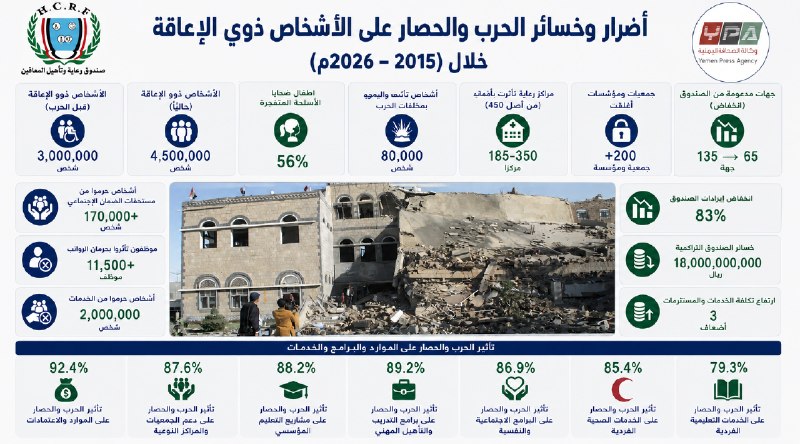
According to a report, the number of persons with disabilities has risen from around 3 million before the Saudi-led aggression coalition began in March 2015 to approximately 4.5 million in 2026, largely due to injuries caused by airstrikes, shelling, prohibited weapons, and the long-term humanitarian and health consequences of the blockade.
The report stated that war-related injuries have resulted in various permanent disabilities, including limb amputations caused by cluster munitions and other explosives, hearing and vision loss, neurological and mobility impairments, severe burns, traumatic injuries, and congenital deformities allegedly linked to prohibited weapons.
It noted that disabilities continue to increase because of unexploded ordnance and remnants of war, with around 80,000 civilians, including many children, sustaining permanent disabilities.
Children reportedly account for 56% of victims of explosive remnants of war, in addition to those affected by malnutrition-related illnesses.
The report said direct attacks and the blockade severely damaged disability care institutions, with services suspended or significantly reduced at between 185 and 350 specialized centers, associations, and institutes out of approximately 450 organizations previously operating.
More than 200 charities and care institutions have reportedly closed because of funding shortages and deteriorating economic conditions.
Among the facilities cited as having been targeted were the Al-Noor Center for the Blind in Sana’a (2016), the Hodeida branch of the Disability Fund, the Al-Amal Association for Children with Intellectual Disabilities in Taiz, and the Taiz Association for Persons with Physical Disabilities.
The report added that the number of organizations supported by the fund has fallen from 135 to about 65, leaving roughly 2 million persons with disabilities without regular access to healthcare, social services, and rehabilitation.
It further stated that restrictions on medical imports have contributed to the deterioration of the healthcare sector, particularly affecting people with disabilities and those with chronic illnesses because of shortages of essential medicines.
The fund also reported that the closure of airports has prevented critically ill patients from traveling abroad for treatment, worsening disability-related conditions and congenital disorders. It added that more than 170,000 persons with disabilities have been deprived of social welfare benefits, while approximately 11,500 employees with disabilities have gone without salaries during the conflict.
According to the report, the fund’s revenues have declined by 83%, with cumulative losses exceeding 18 billion Yemeni rials, while the cost of services, assistive devices, and rehabilitation equipment has nearly tripled.
The report estimated that the conflict and blockade reduced the fund’s resources and services by:
92.4% in financial resources and budget allocations.
87.6% in support for associations and specialized centers.
88.2% in institutional education projects.
89.2% in vocational training and rehabilitation programs.
86.9% in social and psychological support programs.
85.4% in individual healthcare services, and
79.3% in individual educational services.
Despite these challenges, the fund said it has continued, within available resources, to provide emergency medical services, surgeries, assistive devices, and educational support for students with disabilities.
The fund held the Saudi-American coalition responsible for the damage suffered by persons with disabilities and their institutions, attributing it to military operations, airstrikes, shelling, and the humanitarian consequences of the blockade.
It called on the international community, humanitarian organizations, and donors to provide healthcare, rehabilitation, and educational support, facilitate travel abroad for medical treatment by reopening airports and roads, and ensure the delivery of medicines, medical supplies, and assistive devices.
The fund also called for compensation for persons with disabilities for the harm they have suffered and praised the efforts of Yemen’s revolutionary and political leadership and armed forces in defending national sovereignty and seeking to end the blockade.
AA