

Declassified Pentagon files reveal research into mosquito-based biological warfare
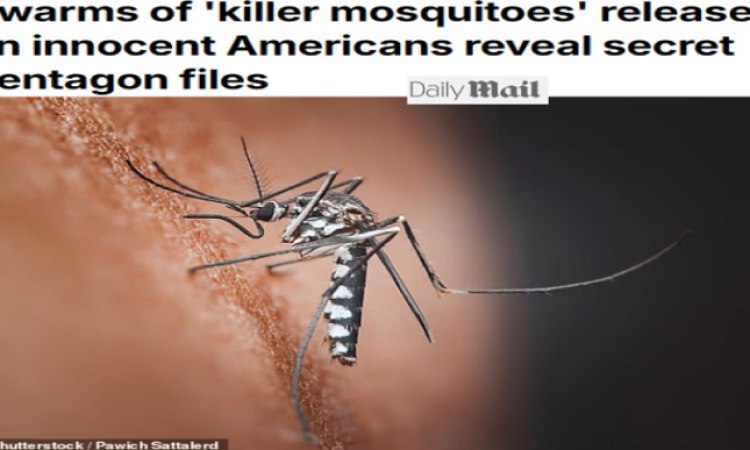
LONDON, June 11 (YPA) – Declassified military documents recently highlighted by the British newspaper Daily Mail have renewed scrutiny of historical Pentagon research programs that explored the military potential of disease-carrying insects, including mosquitoes, during the Cold War era.
The documents detailed experimental projects that examined the use of mosquitoes as biological vectors, assessing their ability to survive, spread, and potentially transmit diseases under various environmental conditions as part of broader biological warfare research.
According to reports citing declassified Pentagon records from the 1950s and 1960s, U.S. military researchers conducted a series of experiments involving mosquitoes to study their survival, dispersal, and ability to transmit diseases under various environmental conditions.
The documents reportedly describe research programs that used Aedes aegypti mosquitoes, a species known for transmitting diseases such as dengue fever and yellow fever.
The studies sought to evaluate the feasibility of using insect vectors in military operations.
One of the programs frequently cited in historical records is Operation Drop Kick, a U.S. Army test conducted in the 1950s that involved releasing mosquitoes to assess their dispersal and survivability after aerial deployment.
Additional documents indicated that military researchers carried out numerous field and laboratory experiments involving insect vectors, including tests designed to evaluate their behavior in different climates and terrains.
The disclosures have also revived debate over other Cold War-era biological research projects and allegations regarding the use of insects in military experiments.
Some commentators have linked these programs to broader discussions about biological warfare, although claims connecting specific diseases to such experiments remain disputed and have not been conclusively established by scientific evidence.
Experts noted that although advances in biotechnology have made it technically possible to modify disease-carrying insects, there is no publicly verified evidence that such insects are currently being used as a practical or effective means of deliberately spreading epidemics on a large scale across entire populations.
AA