

Sayyed Abdul-Malik al-Houthi: Yemeni People will never be a mere file in the Saudi “Special Committee”
Dependence on foreign powers threatens unity:
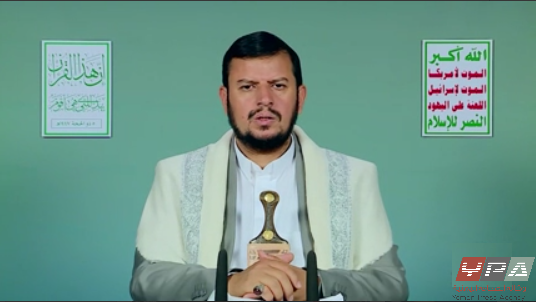
SANAA, May 22 (YPA) – The Leader of the Yemeni Revolution, Sayyed Abdul-Malik Badreddin al-Houthi, asserted on Friday that Yemeni unity is a major national achievement and merit that must always be appreciated, nurtured, preserved, and consolidated on the correct foundations.
He pointed out that all developments following the establishment of unity, up to the present day, have proven that the greatest threats to this achievement are personal, partisan, and factional ambitions and calculations, as well as dependency on foreign powers.
At the beginning of his fourth lecture of the “Lessons from the Month of Thu al-Hijjah” within the series “Indeed, this Quran guides to that which is most suitable,” the Leader explained that “foreign powers seek full control over our people, the confiscation of their freedom and independence, and the exploitation of our country’s strategic location and wealth.”
He noted that the factors guaranteeing the unity of the Yemeni people are twofold: “consolidating the unifying faith-based identity (Al-Huwiyyah Al-Imaniyyah) to remain the launching pad for unity, and the liberationist approach that preserves its independence.”
Sayyed al-Houthi added that “the unifying faith-based identity of our people is what safeguards its unity and makes it a united people in its orientations, stances, and goals. With this faith-based identity, the enemies of our people cannot sow the seeds of division among them.”
He considered that “if all forces and components in this country had turned with sincerity and awareness to hold fast to the rope of Allah, competition would not have led to conflict and crises,” stressing that “the unifying faith-based identity is a primary foundation that preserves brotherhood, unity, and cooperation in righteousness and piety, and shields the people from all factors of division.”
The Leader indicated that “the foreign powers—who do not want this people to be united, free, dignified, strong, and achieving a true renaissance—want them to remain a weak, helpless people, dependent on them.”
He pointed to “the clear and explicit direction of the Saudi regime to keep the Yemeni people subjugated to it, under its command and prohibition, and under American supervision.”
Sayyed al-Houthi reaffirmed that the faith-based identity shields the people from all causes of division and the slogans operated by foreign powers and their tools inside the country. He described “the components that subjugated themselves to foreign powers as having squandered the freedom and dignity of the people and betrayed them in every sense of the word,” adding that “these components moved under various titles to stir up sectarian and regional strife, and to incite enmity, hatred, and malice.”
He stated that “the liberationist approach preserves the country’s independence and effectively helps achieve a true renaissance for our country and people.” He continued: “Our dear people, through their free men, will never accept being a mere file among the files of the Saudi ‘Special Committee,’ managed according to external calculations and interests. Furthermore, our dear people will not accept remaining under the supervision of a quad committee comprising the American, the British, the Israeli, and the Saudi.”
The Leader of the Revolution warned against the continuation of “foreign guardianship, which poses a major threat to Yemen’s freedom, independence, present, and future,” stressing that “it is impossible for our people to submit to foreign guardianship and mortgage their destiny on this basis, given that foreign powers operate according to aggressive, destructive calculations that insult the dignity of our people.”
He emphasized that the Yemeni people, “with their faith-based identity, are committed to their freedom, steadfast in their approach to liberation regardless of the difficulties, challenges, and suffering resulting from the American and Israeli onslaught, along with its regional tools and the traitors among the countrymen.”
Sayyed al-Houthi described the traitors among the countrymen as “pygmies who can never conceive of our people being free, do not believe in it at all, know nothing but dependency on the outside, and care only for achieving their petty gains and ambitions.”
He pointed out that “no matter the difficulties, challenges, and suffering, our dear people remain steadfast in adhering to their faith-based identity and liberationist approach, even though the enemies sought to subjugate the people and control this country using all titles of division, from sectarian strife to ‘Daeshism’ (Takfirism) of the people. They also sought to target our people with the Takfiri distortion to incite enmity and hatred among the sons of this country.”
He concluded with certainty that “the fate of the enemies’ efforts, by the will of Allah, is failure and demise, while survival belongs to the deeply rooted realities within the identity of our people.”
YPA