

On 78th Nakba anniversary, Gaza bleeds as Palestinians mark displacement amid genocidal war
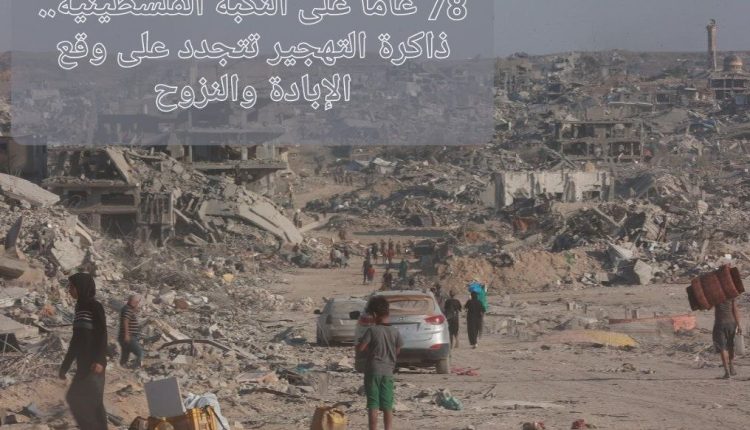
OCCUPIED QUDS, May 15 (YPA) – The 78th anniversary of the Palestinian Nakba comes this year as Palestinians endure one of the most violent and complex phases since the 1948 displacement.
This period is marked by the ongoing Israeli aggression in the Gaza Strip, alongside intensified killings, displacement, and destruction in the occupied West Bank and Al-Quds.
Palestinian observers warn that these developments reflect attempts to impose a renewed form of Nakba through both military force and political measures.
Each year on May 15, Palestinians commemorate the Nakba, which saw the displacement of hundreds of thousands of people from their cities and villages following the establishment of the so-called “Israeli state” in 1948 on most of historical Palestine. The events were carried out by Zionist armed groups, resulting in the destruction of Palestinian communities and a profound demographic transformation of the region.
This year’s commemoration is held under the slogan: “We will not leave… Our roots are deeper than your destruction.” Across the West Bank, Gaza Strip, refugee camps, and diaspora communities, Palestinians organized marches, public gatherings, and cultural events reaffirming their national identity and, most prominently, their right of return.
In Ramallah, a central march and festival witnessed broad official and popular participation. Demonstrators raised Palestinian flags, black mourning banners, and symbolic keys representing the right of return.
Similar events took place in refugee camps across several Arab and foreign countries, where participants carried the names of villages and cities lost in 1948, reinforcing collective historical memory.
However, this year’s commemoration unfolds amid escalating violence. The West Bank is experiencing heightened Israeli military activity, including raids, arrests, and widespread confrontations—most notably during the recent incursion into Nablus. These developments deepen the sense of instability and reinforce the perception that the Nakba is not only a historical event but an ongoing process.
Indeed, the Nakba has evolved in Palestinian discourse from a singular historical catastrophe into a continuous condition of displacement and dispossession. It now encompasses refugeehood, land confiscation, denial of return, recurring wars, and prolonged sieges.
According to the Palestinian Central Bureau of Statistics, Zionist forces in 1948 seized control of 774 Palestinian towns and villages, destroyed 531 of them, and carried out more than 70 massacres that resulted in the killing of over 15,000 Palestinians. These events formed the foundation of the modern Palestinian refugee crisis.
Demographically, the Palestinian population has grown significantly despite displacement.
By the end of 2025, Palestinians numbered approximately 15.49 million worldwide, more than half of whom live outside historical Palestine, including 6.82 million in Arab countries.
Within historical Palestine, the population of the State of Palestine is estimated at 5.56 million, including 3.43 million in the West Bank and 2.13 million in Gaza.
Notably, Gaza has experienced a sharp population decline of approximately 254,000 people since the outbreak of the Israeli genocidal war in October 2023, attributed to killing, displacement, and deteriorating humanitarian conditions.
The current Nakba anniversary coincides with the continuation of the Israeli aggression on Gaza, despite a ceasefire agreement in force since October 10, 2025. Nevertheless, Palestinians describe ongoing developments as a continuation of forced displacement patterns, with mass evacuation orders, repeated bombardment, and widespread destruction of civilian infrastructure making large areas uninhabitable.
In Gaza, forced displacement has become a daily reality. Hundreds of thousands have been ordered by the Israeli occupation to leave their homes under military pressure, while extensive destruction has rendered return impossible for many communities. Palestinians view these actions as a continuation of historical displacement practices under new operational forms.
Across Gaza, the West Bank, and Al Quds, Palestinians argued that current policies—ranging from Zionist settlement expansion and home demolitions to military escalation and legislation targeting prisoners—reflect a broader strategy of control and dispossession under an increasingly hardline political environment.
Ultimately, the 78th anniversary of the Nakba underscores a persistent historical continuity in the Palestinian experience.
Between the original displacement in 1948 and the ongoing upheaval in Gaza today, the core elements of the issue remain unchanged in Palestinian perception: displacement, loss of land, and the enduring demand for the right of return.
Despite decades passing, the memory of destroyed villages and the aspiration for return remain central to Palestinian collective identity, sustaining a narrative that links past and present in a single, ongoing historical trajectory.
AA