

Direct Emirati threat to Al-Alimi sparks Saudi anger, Washington warns of clash in Yemen

SANAA, Dec. 23 (YPA) -The United Arab Emirates (UAE) has sent direct threat messages to Rashad Al-Alimi, head of Yemen’s Presidential Leadership Council (PLC), calling on him to leave the political scene “with dignity,” sources said. Al-Alimi is currently based in the Saudi capital, Riyadh.
UAE presidential adviser Abdulkhaleq Abdullah wrote on X, addressing Al-Alimi: “Your esteemed Presidential Council no longer has a presence on the ground and has not held a full meeting of all its members. Your council has not advanced a single step toward Sanaa, and several of your ministers have submitted their resignations.”
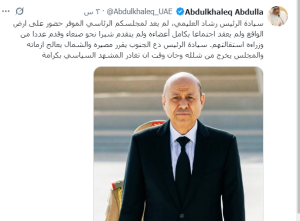
Abdullah also urged Al-Alimi to “leave the southern governorates of Yemen alone” under what he described as “self-determination,” and called on him to step aside from the political scene with dignity.
These remarks seen by Yemeni observers and political analysts as a direct threat.
Meanwhile, Saudi journalist Ali Al-Arishi wrote on X that the Southern Transitional Council’s (STC) stubbornness, combined with its hostility toward and systematic targeting of the internationally recognized government, may compel the government to defend its legitimacy “by all available means.”
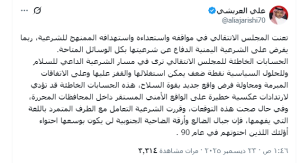
He added that miscalculations of the STC, “by bypassing signed agreements and attempting to impose a new reality by force of arms,” could lead to “serious negative repercussions for the currently stable security situation.”
“If the so-called legitimate government decides to confront what he described as the STC’s rebellion, “the mountains of Dhalea and the so-called southern suburb will not contain it,” he warned, in remarks viewed as an implicit Saudi threat toward the UAE-backed STC.
Separately, a report by the Washington Institute stated that US allies, (Saudi Arabia and the United Arab Emirates) are heading toward confrontation in Yemen.
A report by researcher April Longley Alley stated that Yemen experienced a major shift in December following the takeover of the oil-rich Hadramout governorate, bordering Saudi Arabia, and Mahra governorate, bordering Oman, by UAE-backed forces.
According to the report, developments in eastern Yemen are “not an internal matter,” but rather a reflection of sharp tensions between Saudi Arabia and the UAE—both US allies—stemming from their disagreements in Sudan.
It added that high-level US intervention is ongoing to reduce the risk of a Saudi-Emirati clash in Yemen, noting that the Trump administration has proposed urgently convening America’s Gulf allies to calm the current crisis and lay the groundwork for broader, long-term agreements.
Nevertheless, the report noted that while Hadramout is not traditionally a stronghold of STC leadership, those leaders view the governorate’s oil and natural resources as essential for declaring a secessionist state in southern Yemen.
It also highlighted concerns among Hadramout residents about a return to repressive policies by the southern forces, similar to those that prevailed before Yemeni unity.
The report concluded that the STC’s advance into Hadramout and Mahra comes amid escalating Saudi-Emirati tensions over foreign policy issues, including recent talks between Riyadh and the Trump administration on ending the war in Sudan.
It warned that clashes could erupt in Wadi Hadramout between Saudi- and Emirati-backed forces if the two countries fail to contain their differences.
The report noted that STC leaders recognize the danger of international isolation if they pursue secession at this time, warning that any Saudi efforts to politically isolate the STC could push it to declare independence away from the coalition-backed government.
@E.Y.M