

From military buildup to front lines: Sanaa’s strategy dismantles Saudi ground offensive
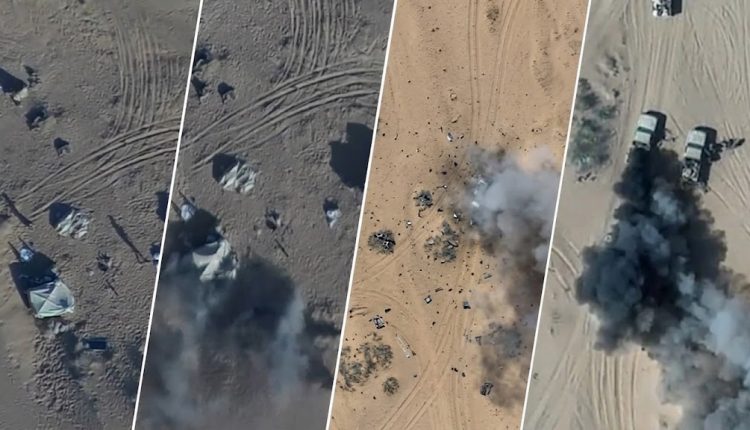
SANAA, Aug. 30 (YPA) – The nature of the strikes carried out by the Yemen’s Sanaa-based armed forces against Saudi-backed troop concentrations and military positions reveals a preemptive military approach that does not wait for a ground offensive to begin before confronting it. Instead, it targets the foundations of such an offensive during the stages of preparation, mobilization, and deployment, thereby weakening the attacking force before it reaches the stage of field execution.
The footage released by the war media today, showing attacks on gatherings and military vehicles belonging to Saudi-backed forces on several fronts using Rajum drones, comes within this framework.
This coincides with a statement by a military source in the Sanaa forces that the latest strikes have thwarted Saudi Arabia’s arrangements and ongoing preparations for a ground offensive.
These developments indicate that the attacks are not isolated operations, but rather part of a preemptive campaign aimed at dismantling the force structure required for any ground offensive to move from a military plan to an executable field operation.
Striking the Components of an Offensive
An examination of the targets struck by the Sana’a forces in recent weeks reveals a clear distribution of firepower according to the function of each target within the offensive system.
Missiles and drones have targeted military concentrations, camps, assembly points, and support centers in Hadramout, Marib, Mocha, and several districts of Taiz province. These attacks have focused on manpower, mobilization centers, weapons depots, firepower, and logistical support—elements expected to provide attacking forces with the capability to launch and sustain an operation.
At another level, Rajum drones have targeted smaller gatherings, military vehicles, and forward positions. These are the elements expected to move from the mobilization phase to actual execution and could serve as potential launching and staging points for any ground movement along the front lines.
Thus, the strikes have targeted the various links that a ground offensive requires: manpower, mobilization centers, weapons and logistical support, military vehicles, and forward positions.
This clarifies the nature of Sana’a’s approach: it is targeting the attacking force both in its depth and at the forefront of its deployment, preventing it from easily transitioning from force-building to the actual use of that force in a ground offensive.
Distribution of the Strikes
Under this approach, a ground offensive does not begin when troops start moving. It begins much earlier, with mobilization, the movement of military vehicles, the preparation of forward positions, and the establishment of support networks.
For this reason, the strikes are distributed across different stages of preparation, using means suited to the nature of each target.
When missiles and drones strike camps, troop concentrations, and support centers, they target the depth that is supposed to provide the manpower, firepower, and logistical capabilities required for the operation.
When Rajum drones and other systems target gatherings, military vehicles, and forward positions, they strike the field-level elements expected to turn those preparations into military movement on the ground.
Consequently, the process of building an attacking force itself becomes part of the battlefield. Every mobilization effort, movement of military vehicles, or establishment of a forward position becomes vulnerable to attack before it can fulfill its intended role in an offensive.
Undermining the Factors of Military Strength
Any ground offensive requires cohesive manpower, operational military vehicles, staging and deployment positions, weapons and ammunition stocks, and sufficient firepower and logistical support to sustain the operation.
But when these components are subjected to continuous attacks, the force expected to launch the offensive reaches the point of deployment already suffering from attrition and reduced readiness.
In other words, preemptive strikes do not target troops alone; they target the environment and fundamental requirements of the offensive.
They strike mobilization centers before the force is fully assembled, military vehicles before they enter the battlefield, forward positions before they become launching points, and support networks before they can provide assistance to the operation.
This means the challenge facing the Saudi plan does not begin with confronting defending forces after an offensive has been launched. It begins much earlier, with the attempt to build a cohesive attacking force and maintain its readiness and concentration.
A Formula That Undermines the Ground Option
The essence of the equation imposed by Sanaa, therefore, is not simply to repel a ground offensive after it begins, but to undermine the factors that make such an offensive possible in the first place.
The longer strikes continue against camps, troop concentrations, military vehicles, forward positions, and support networks, the more difficult it becomes to assemble and move an attacking force toward the front lines while maintaining the concentration, readiness, and momentum required for a ground operation.
The battle consequently shifts from confronting an offensive to preventing its formation. Sana’a is seeking to dismantle its components before they are fully assembled, making the reconstruction of a field-ready attacking force increasingly difficult and costly.
Accordingly, the continuation of this equation could undermine the Saudi ground plan, as the strikes do not wait for attacking forces at the front lines. Instead, they target the elements that are supposed to give those forces the ability to reach the front lines and launch an offensive.
In this sense, Sanaa is not merely preparing to repel any ground advance; it is seeking to undermine its foundations from the preparation stage by targeting troop concentrations in camps, support centers, military vehicles, gatherings, and forward positions.
This equation presents any attempt to launch a ground offensive—whether broad or limited—with a major operational dilemma. The challenge becomes not merely the ability of the attacking force to fight once the battle begins, but its ability to assemble, maintain readiness, and protect itself until the moment of deployment.
As a result, the continuation of such preemptive strikes would gradually erode the fundamental requirements of a Saudi ground option, potentially making it increasingly difficult to execute in the field, as the force intended to carry out the offensive faces attrition and structural disruption before reaching the point of execution.
Aa